
Search
Did you mean: Quran?
Remove Ads
Advertisement

 This answer was generated by
 Search Results
Definition
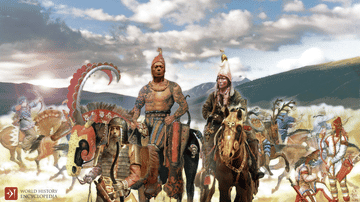
Scythians
The Scythians were a nomadic people whose culture flourished between the 7th and 3rd century BCE in a territory ranging from Thrace in the west, across the steppe of Central Asia, to the Altai Mountains of Mongolia in the east. This...

Definition
Scythian Art
Scythian art is best known for its 'animal art.' Flourishing between the 7th and 3rd centuries BCE on the steppe of Central Asia, with echoes of Celtic influence, the Scythians were known for their works in gold. Moreover, with the...

Article
Parthian-Scythian Relations
While little is written about Parthian-Scythian relations, not only did the Parthians share origins with the Scythians and cooperated militarily but social, cultural, and commercial interactions were likely as well. Essentially...
Definition
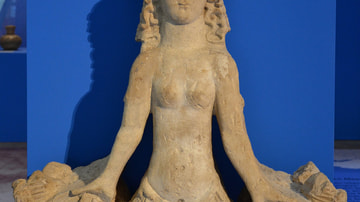
Scythian Religion
Scythian religion appears to be an amalgam of belief in a pantheon of gods grafted to more ancient animal reverence and shamanistic practice. According to their burial finds, the Scythians appear to have had a deep affinity with...

Definition
Parthian Art
Parthian art flourished within the Eurasian cultural corridor from the late hundreds BCE to the early 1st and 2nd centuries CE. With the Parthian Empire (247 BCE - 224 CE) stretching from India and China in the east to the Mediterranean...

Article
Scythian Territorial Expanse
With 7600 perimeter miles (12,231 km), the Scythians roamed and ruled over an astonishing 1.5 million mi² (2.4 million km²) of territory between the 7th and 3rd centuries BCE. Although building an empire was never in...
Definition
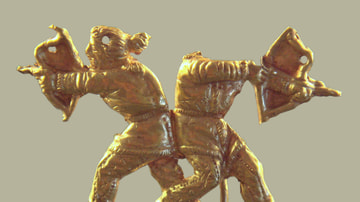
Scythian Warfare
Scythian warfare used state-of-the-art recurve bows and hit-and-run tactics against set infantry formations. Working from nimble horses, Scythian warriors could unleash a cloud of lethal arrows. Known, too, for their innovative...
Image
Map of the Scythian Expanse, c. 700-300 BCE
The westward expansion of the Scythians (c. 700–300 BCE) illustrates how mobile steppe societies could reshape the political and cultural landscapes of Eurasia without building territorial empires. Originating...
Image
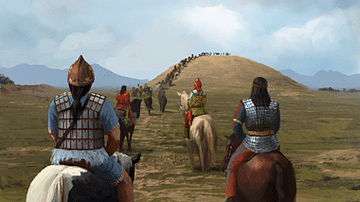
Scythian Funeral Procession
Artist's impression of how a Scythian funeral process may have looked like. A typical Scythian burial mound (or kurgan) is visible in the background.
Image
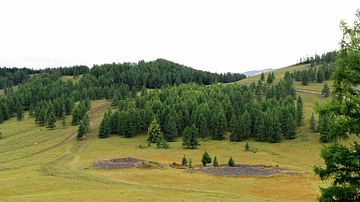
Pazyryk Kurgans
The Pazyryk burials are a series of Iron Age Scythian tombs in the Ukok Plateau, Siberia. The tombs are dated to between the 4th and 3rd Century BCE.
