
Celebrate Our Anniversary with Trivia!
Join us on August 23 for a free virtual trivia party featuring questions about ancient civilizations, U.S. history, unusual historical facts, pop culture, and more.


This fragment was rediscovered in Davati village, located in eastern Georgia, in 1980. It was originally made in the 6th century CE from limestone. The standing figure of the Virgin Mary represents a unique iconographic type of the Virgin, coming from the oldest "Hodigitria-type." Next to the figures of the Virgin and baby Jesus are "condensed" inscriptions; "St. Mary" and "Jesus Christ." Steles or stone crosses ("kvajvari" in Georgian) are cult monuments carved from stone that were typical for the early Christian period in Georgia (c. 300-750 CE). Many of these steles have survived because they were reused as construction material for churches erected in the Middle Ages and Early Modern era. (Georgian National Museum, Tbilisi)
About the Author

Related Images
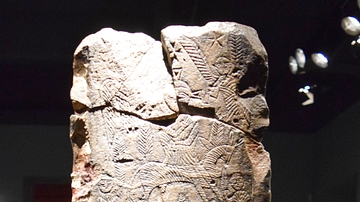
Christian Stele from Georgia with Scenes of Christ's Life

Georgian Triptych of the Virgin Mary

House of the Virgin Mary
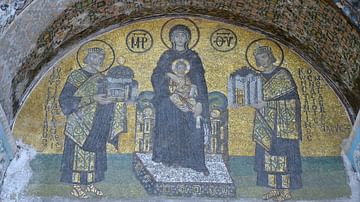
Mosaic with the Virgin Mary, Constantine and Justinian, Hagia Sophia
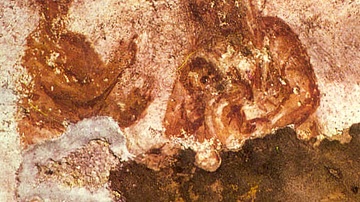
Virgin and Child with Balaam the Prophet

Virgin and Child with St. Anne by Leonardo da Vinci
Cite This Work
APA Style
Wiener, J. B. (2017, October 03). Fragment of a Stele of the Virgin Mary from Georgia. World History Encyclopedia. https://www.worldhistory.org/image/7363/fragment-of-a-stele-of-the-virgin-mary-from-georgi/
Chicago Style
Wiener, James Blake. "Fragment of a Stele of the Virgin Mary from Georgia." World History Encyclopedia, October 03, 2017. https://www.worldhistory.org/image/7363/fragment-of-a-stele-of-the-virgin-mary-from-georgi/.
MLA Style
Wiener, James Blake. "Fragment of a Stele of the Virgin Mary from Georgia." World History Encyclopedia, 03 Oct 2017, https://www.worldhistory.org/image/7363/fragment-of-a-stele-of-the-virgin-mary-from-georgi/.
