
Celebrate Our Anniversary with Trivia!
Join us on August 23 for a free virtual trivia party featuring questions about ancient civilizations, U.S. history, unusual historical facts, pop culture, and more.


The starting line or 'balbis' consisted of 12 lanes with posts held in vertical sockets between which a catapult mechanism or 'hysplex' of tensed rope would prevent any athlete from false starting. A judge would simultaneously release the rope blocking the athletes. The rope or twisted sinews were at two heights (knee and waist); when released they would lie flat on the ground between the first footfalls of the athletes. Therefore, if an athlete tripped, they would have started too early. The double lines in the stone blocks were for athletes to place their toes in to ensure all started equally. A statue would have stood at either end of the balbis. 330-320 BCE.
About the Author
Related Images

Ancient Stadium, Nemea, Greece

Stadium Entrance Tunnel (East End), Nemea, Greece
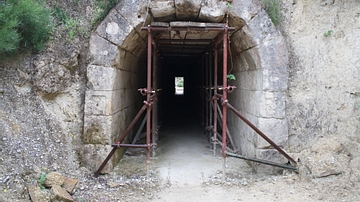
Stadium Entrance, Nemea, Greece

Starting Blocks, Olympia
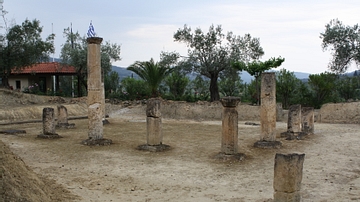
Athletes Locker Room, Nemea, Greece

The Bath, Nemea, Greece
Cite This Work
APA Style
Cartwright, M. (2012, May 09). Stadium Starting Block, Nemea, Greece. World History Encyclopedia. https://www.worldhistory.org/image/615/stadium-starting-block-nemea-greece/
Chicago Style
Cartwright, Mark. "Stadium Starting Block, Nemea, Greece." World History Encyclopedia, May 09, 2012. https://www.worldhistory.org/image/615/stadium-starting-block-nemea-greece/.
MLA Style
Cartwright, Mark. "Stadium Starting Block, Nemea, Greece." World History Encyclopedia, 09 May 2012, https://www.worldhistory.org/image/615/stadium-starting-block-nemea-greece/.
