
Celebrate Our Anniversary with Trivia!
Join us on August 23 for a free virtual trivia party featuring questions about ancient civilizations, U.S. history, unusual historical facts, pop culture, and more.


The Latin inscription on this dish, reading D.D.ICRESCONI CLARENT ("Gift given to the distinguished Cresconii"), identifying the family who owned the Carthage Treasure as Cresconii. They were prominent North African family of the 300s to 400s CE, whose members included high-ranking civil servants and members of the clergy. 300s-400s CE. From the Hill of St. Louis, Tunisia. The Carthage Treasure comprises 31 pieces of jewellery and silver tableware, dating from around 400 CE. The treasure was found in Carthage, modern-day Tunisia. It is thought to have been buried for safekeeping by the prominent Cresconii family at a time of crisis, possibly when the city was attacked by the Germanic Vandal King Gaiseric in 439 CE. Bequeathed by Sir Augustus Wollaston Franks. (The British Museum, London).
About the Author

Related Images
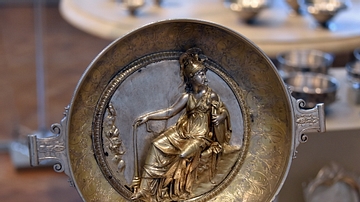
Seated Athena Dish from the Hildesheim Silver Treasure
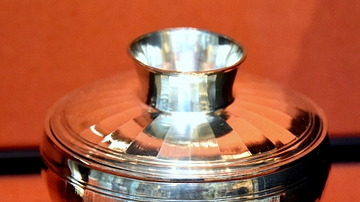
Silver Lidded Bowl from the Carthage Treasure
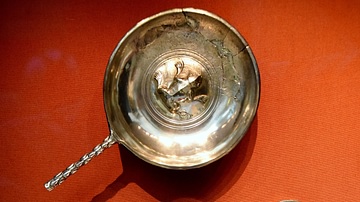
Spoons & Patera from the Carthage Treasure

Parure of Jewellery from the Carthage Treasure
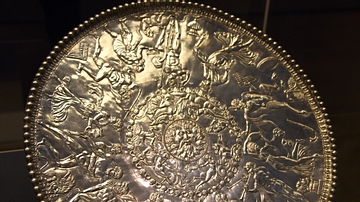
The Mildenhall Great Dish
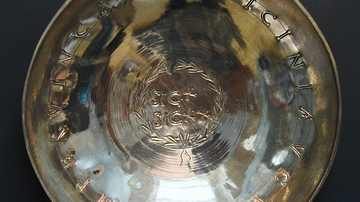
Silver Largitio Dish with the Name of Licinius
Cite This Work
APA Style
Amin, O. S. M. (2016, October 02). Inscribed Dish from the Carthage Treasure. World History Encyclopedia. https://www.worldhistory.org/image/5752/inscribed-dish-from-the-carthage-treasure/
Chicago Style
Amin, Osama Shukir Muhammed. "Inscribed Dish from the Carthage Treasure." World History Encyclopedia, October 02, 2016. https://www.worldhistory.org/image/5752/inscribed-dish-from-the-carthage-treasure/.
MLA Style
Amin, Osama Shukir Muhammed. "Inscribed Dish from the Carthage Treasure." World History Encyclopedia, 02 Oct 2016, https://www.worldhistory.org/image/5752/inscribed-dish-from-the-carthage-treasure/.
