
Search
Did you mean: Writing?
Remove Ads
Advertisement
Search Results
Image
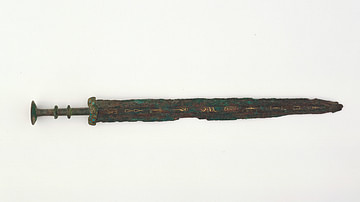
Eastern Zhou Sword
A bronze, double-edged straight sword from the Eastern Zhou Dynasty. Decorated with turqoise and gold. Warring States Period, c. early 5th century BCE. China. (Courtesy of the Smithsonian Institute)
Image
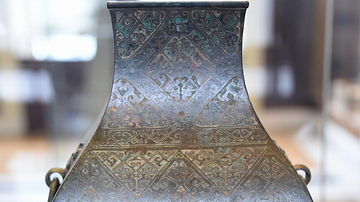
Chinese Bronze Fanghu Vessel
This ritual alcohol vessel is inlaid with malachite and copper wire. Eastern Zhou period, Warring States period, 475-221 BCE. From modern-day China. Anonymous loan. (The British Museum, London).

Definition
Julius Caesar
Gaius Julius Caesar was born 12 July 100 BCE (though some cite 102 as his birth year). His father, also Gaius Julius Caesar, was a Praetor who governed the province of Asia and his mother, Aurelia Cotta, was of noble birth. Both held to the...

Definition
Roman Republic
In the late 6th century BCE, the small city-state of Rome overthrew the shackles of monarchy and created a republican government that, in theory if not always in practice, represented the wishes of its citizens. From this basis the city would...

Definition
Ancient Chinese Art
Ancient China covered a vast and ever-changing geopolitical landscape, and the art it produced over three millennia is, unsurprisingly, just as varied. Still, despite continuous indigenous technical developments, changes in materials and...

Definition
Shogun
The shoguns of medieval Japan were military dictators who ruled the country via a feudal system where a vassal's military service and loyalty was given in return for a lord's patronage. Established as an institution by the first shogun proper...
Definition
American Civil War - The Birthpangs of the United States
The American Civil War (1861-1865) was the pivotal event in United States history and the largest armed conflict in the Western world following the end of the Napoleonic Wars (1815) and prior to the beginning of the First World War (1914...

Definition
Hammurabi - Conquerer, King, and Law-Giver
Hammurabi (reign 1792-1750 BCE) was the sixth king of the Amorite First Dynasty of Babylon, best known for his famous law code, which served as the model for others, including the Mosaic Law of the Bible. He was the first ruler able to successfully...

Definition
Mandate of Heaven
The Mandate of Heaven (Tianming), also known as Heaven's Mandate, was the divine source of authority and the right to rule of China's early kings and then emperors. The ancient god or divine force known as Heaven or Sky selected a particular...

Definition
Shang Dynasty
The Shang Dynasty (c. 1600-1046 BCE) was the second dynasty of China, which succeeded the Xia Dynasty (c. 2070-1600 BCE) after the overthrow of the Xia tyrant Jie by the Shang leader, Tang. Since many historians question whether the Xia Dynasty...
