
Search
Did you mean: Vejovis?
Remove Ads
Advertisement
Search Results
Definition
Paestum
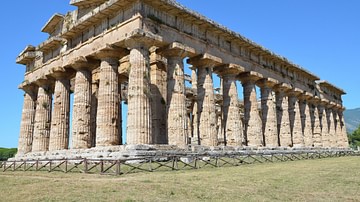
Paestum, also known by its original Greek name as Poseidonia, was a Greek colony founded on the west coast of Italy, some 80 km south of modern-day Naples. Prospering as a trade centre it was conquered first by the Lucanians and then, with...

Definition
Pliny the Elder
Aside from the usual contributions of its noble politicians and military commanders, the story of a nation also records the invaluable literary influences of its poets, dramatists, and historians. The long history of the Roman Empire is no...

Article
Legacy of the Ancient Romans
The legacy of the ancient Romans – from both the time of the Roman Republic (509-27 BCE) and the time of the Roman Empire (27 BCE - 476 CE) – exerted a significant influence on succeeding cultures and is still felt around the world in the...

Article
The Spartacus Revolt
The revolt of the gladiator Spartacus in 73-71 BCE remains the most successful slave revolt in the history of Rome. The rebellion is known as the Third Servile War and was the last of three major slave revolts which Rome suppressed. The story...

Article
The Home Fronts in World War I - The Effects of Total War on Civilians
The First World War (1914-18) saw fighting on an unprecedented scale but also involved civilians as never before. For the first time, people hundreds of miles from the fighting front were vulnerable to air attacks. The war at sea dramatically...

Article
Eyewitness Accounts of WWI
The First World War (1914-18) was the first truly global conflict and the first to be fully mechanised. Armies clashed across continents on land, in the air, and at sea. Civilians were caught up in the destruction as never before. In this...
Article
Childbirth in Ancient Rome
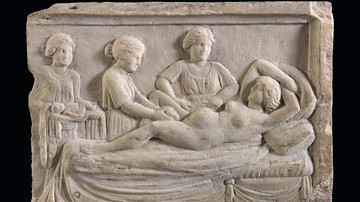
Childbirth in ancient Rome was considered the main purpose of marriage. Roman girls married in their early teens, and in elite society, some married before they reached puberty. The legal age for marriage was 12 for a girl; 15 was accepted...

Article
Pompeii: Graffiti, Signs & Electoral Notices
The Roman town of Pompeii was preserved in metres of volcanic material following the cataclysmic eruption of Mt. Vesuvius in 79 CE. Often, we may experience the ancient past only through the second-hand interpretations of historians and archaeologists...

Article
Dogs & Their Collars in Ancient Rome
Dogs were highly valued in ancient Rome, as they were in other cultures, and the Roman dog served many of the same purposes as it did in, say, Egypt and Persia - as hunters, guardians, and companions - but with a significant difference in...

Article
Pliny the Younger on Christianity
Pliny the Younger's (61-112 CE) letter (Epistulae X.96) to Roman Emperor Trajan (r. 98-117 CE) is one of our earliest sources on Christianity from an outsider's point of view. It highlights the Christian movement's impact on the old Roman...
