
Search
Did you mean: Bassae?
Remove Ads
Advertisement
Search Results

Definition
William I of Scotland
William I of Scotland, also known as 'William the Lion' after his heraldic emblem, reigned from 1165 to 1214 CE. Succeeding his elder brother Malcolm IV of Scotland (r. 1153-1165 CE), William was faced with a shrinking kingdom, but he harboured...

Definition
Zakutu
Zakutu (l. c. 728 - c. 668 BCE) was the Akkadian name of Naqi’a, a secondary wife of Sennacherib of Assyria (r. 705-681 BCE). Though she was not Sennacherib's queen, she bore him a son, Esarhaddon, who would succeed him. She may have ruled...

Definition
Alexander III of Scotland
Alexander III of Scotland reigned from 1249 to 1286 CE. Succeeding his father Alexander II of Scotland (r. 1214-1249 CE) at the age of eight, the young king's early reign was blighted by rivalries between his nobles, a situation made more...

Definition
Khotyn Fortress
Khotyn fortress is a complex of fortifications situated on the hilly right bank of the Dniester in Khotyn, Ukraine. It consists of a 13th-century stronghold and an 18th-century bastion surrounding it. It is one of the oldest preserved fortifications...

Definition
Polycrates
Polycrates (r. c. 535-522 BCE) was the tyrant of Samos who established Samian naval supremacy in the eastern Aegean and strove for control of the Aegean Sea and mainland towns of Ionia in the 6th century BCE. Polycrates had a successful career...
Definition
Ancient Judean Technology
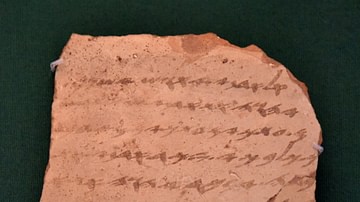
Though the kingdom of Judah was not particularly notable in terms of technological developments, technology, nonetheless, played a central role in its rise as a political power in the region. Emerging in the 10th century BCE, it reached its...

Article
Saladin & the Unification of the Muslim Front: 1169-1187 CE
Saladin (c. 1137 – 1193 CE), the Muslim ruler who crushed the mighty Crusader army at the Horns of Hattin (1187 CE) and re-took Jerusalem after 88 years of Crusader control, was born in a world where the disunity of the Muslims had allowed...

Article
Zengids & the Crusaders: Race for Egypt (1163-1169 CE)
In the aftermath of the failure of the Second Crusade (1147-1149 CE), which only managed to bring Damascus under Nur ad-Din's (sometimes also given as Nur al-Din, l. 1118-1174 CE) dominion, Egypt acquired top priority – both from a strategic...

Definition
Ramesses II
Ramesses II (r. 1279-1213 BCE, alternative spellings: Ramses, Rameses) was known to the Egyptians as Userma'atre'setepenre, which means 'Keeper of Harmony and Balance, Strong in Right, Elect of Ra'. He is also known also as Ozymandias and...

Definition
Ancient Japan
Ancient Japan has made unique contributions to world culture which include the Shinto religion and its architecture, distinctive art objects such as haniwa figurines, the oldest pottery vessels in the world, the largest wooden buildings anywhere...
