
Search
Remove Ads
Advertisement
Search Results

Image
Lambayeque Tumi
A tumi or ceremonial knife made by the Lambayeque civilization (Sican) of northern Peru, 10-11th century. Gold and silver inlaid with turquoise.(Metropolitan Museum of Art, New York)

Image
Aztec Double-Headed Serpent (Detail)
A detail of the celebrated Aztec double-headed serpent. It is made from wood covered in turquoise mosaic, spondylus (red) and conch (white) shell. The eyes would have been rendered with inlay, probably of iron pyrite. The piece is believed...

Image
Mask of Xiuhtecuhtli
A turquoise mosaic mask representing Xiuhtecuhtli, the Aztec god of fire, 1400-1521 CE. The mask is of cedar wood with mother-of-pearl eyes, conch shell teeth and once with gold leaf on the eyelids. (The British Museum, London).

Image
Lambayeque Ceremonial Knife
A ceremonial knife (or tumi) from the Lambayeque civilization (Sican) of northern Peru, 9-11th century. Gold and silver inlaid with turquoise.
Metropolitan Museum of Art, New York.
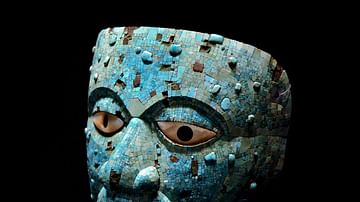
Image
Xiuhtecuhtli
A turquoise mosaic mask representing Xiuhtecuhtli, the Aztec god of fire, 1400-1521 CE. The mask is of cedar wood with mother-of-pearl eyes, conch shell teeth and once with gold leaf on the eyelids. (The British Museum, London).

Image
Mask of Xiuhtecuhtli (Detail)
A detail of a turquoise mosaic mask representing Xiuhtecuhtli, the Aztec god of fire, 1400-1521 CE. The mask is of cedar wood with mother-of-pearl eyes, conch shell teeth and once with gold leaf on the eyelids. (The British Museum, London).
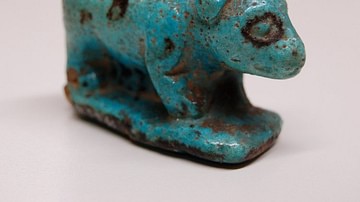
Image
Egyptian Toy Dog
A toy dog in glazed turquoise, Middle Kingdom of Egypt (2040-1782 BCE).
The British Museum, London.
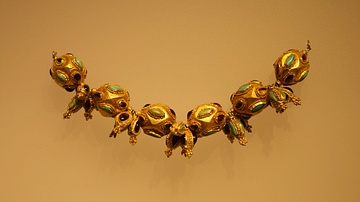
Image
Georgian Bead-Pendants
These bead-pendants with pyrope and turquoise gems were found in Samtavro, vault no. 905, in what is modern Georgia. They were made between the 2nd and 3rd centuries BCE. (Georgian National Museum, Tbilisi)

Definition
Old Kingdom of Egypt
The Old Kingdom of Egypt (c. 2613-2181 BCE) is also known as the 'Age of the Pyramids' or 'Age of the Pyramid Builders' as it includes the great 4th Dynasty when King Sneferu perfected the art of pyramid building and the pyramids of Giza...

Definition
Chichen Itza
Chichen Itza, located at the northern tip of the Yucatán Peninsula of modern Mexico, was a Maya city which was later significantly influenced by the Toltec civilization. Flourishing between c. 750 and 1200 CE, the site is rich in monumental...
