
Search
Remove Ads
Advertisement
Search Results

Definition
Egyptian Papyrus
Papyrus is a plant (cyperus papyrus) which once grew in abundance, primarily in the wilds of the Egyptian Delta but also elsewhere in the Nile River Valley, but is now quite rare. Papyrus buds opened from a horizontal root growing in shallow...
Image
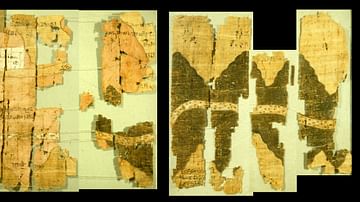
Turin Papyrus Map
The Turin Papyrus Map is an ancient Egyptian map of gold mines in the Eastern Desert. It is considered to be one of the oldest surviving topographical maps. Made c. 1150 BCE by Scribe-of-the-Tomb Amennakhte, son of Ipuy. (Turin Museum)

Definition
The Westcar Papyrus
The ancient Egyptians enjoyed storytelling as one of their favorite pastimes. Inscriptions and images, as well as the number of stories produced, give evidence of a long history of the art of the story in Egypt dealing with subjects ranging...

Article
Ancient Egyptian Medical Texts
Medicine in ancient Egypt was understood as a combination of practical technique and magical incantation and ritual. Although physical injury was usually addressed pragmatically through bandages, splints, and salves, even the broken bones...
Article
The Papyrus Lansing: Be A Scribe…Or Else!
The Papyrus Lansing is an ancient Egyptian document that dates to the reign of the Pharaoh Senusret III (also known as Sesostris III, and, arguably, the legendary Sesostris written of by Herodotus) the 5th ruler of the 12th Dynasty of Egypt...
Article
Stories from the Westcar Papyrus
The Westcar Papyrus, dated to the Second Intermediate Period of Egypt (1782 - c.1570 BCE), but most likely written during the Middle Kingdom (2040-1782 BCE), contains some of the most interesting tales from ancient Egypt. The papyrus takes...
Article
Egyptian Medical Treatments
The ancient Egyptians experienced the same wide array of disease that people do in the present day, but unlike most people in the modern era, they attributed the experience to supernatural causes. The common cold, for example, was prevalent...

Article
New Testament Text-Types
The books of the New Testament were written in the 1st century CE. As Christianity spread in the 2nd century CE, many copies were made, some by non-professionals. Early manuscripts are considered to be closer to the original than later manuscripts...

Image
Battle of Turin, 312 CE
An illustration of the Battle of Turin (312 CE) fought between the forces of Constantine I (r. 306-337 CE) and Maxentius (r. 306-312). Illustration by Sean Ó’Brógáín.
Image
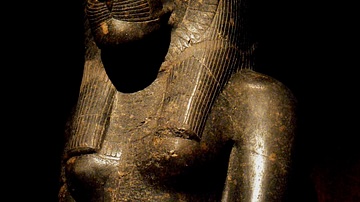
Statue of Sekhmet, Turin
Statue of Sekhmet. Granodiorite. Reign of Amenhotep III (c. 1386-1353 BCE), 18th Dynasty. (Egyptian Museum, Turin)
