
Search
Did you mean: Trajan's Column?
Remove Ads
Advertisement
Search Results

Image
Syrian Column Capital
The half-palmettes on this column capital made from marble are ultimately derived from ancient Assyrian models. Stylization transforms its more recent Hellenistic predecessors. This specimen dates from the late 7th-early 8th...
Image
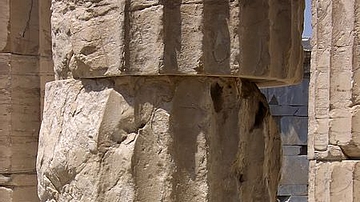
Column Flutes, Propylaea
Fluted column drums from the Propylaea of the Athenian acropolis, 5th century BCE.

Image
Igel Column
The Igel Column is a multi-storey Roman sandstone funerary monument located on the left bank of the Moselle some eight kilometres south of Trier. It was erected around 250 CE by two wealthy merchants of Celtic origin, the brothers...
Image
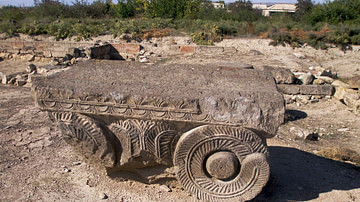
Column Capital, Cathedral of Dvin
A column capital from the cathedral of Saint Gregory at the former medieval capital of Dvin in Armenia. 4th century CE.
Image
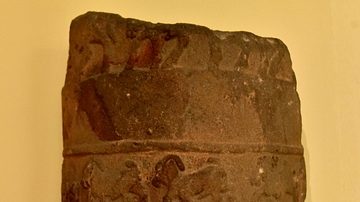
Relief Column Fragment from Madain Saleh
This sandstone fragment of a column depicts striding animals. Second Century CE. From Madain Saleh, in modern-day Saudia Arabia. (Ancient Orient Museum, Istanbul, Turkey).
Image
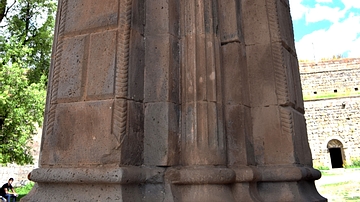
Armenian Column outside Church of St. Pogos and Petros
This is an Armenian column outside the Church of St. Pogos and Petros at Tatev Monastery in Armenia. This church was originally built c. 895-906 CE.

Article
Battle of Rivoli
The Battle of Rivoli (14-15 January 1797) was the climactic battle of Napoleon's Italian Campaign of 1796-97. A fourth and final attempt by the Austrian army to relieve the siege of Mantua was thwarted by Napoleon Bonaparte's...

Article
Caesarea Maritima's Role in the Roman Empire
Caesarea Maritima, the city Herod the Great (r. 37-4 BCE) built for Rome on the southeastern coast of the Mediterranean served as the Roman Empire's powerbase of operations both commercially and militarily...
Video
Caryatid & Ionic Column, Erechtheion, 421-407 B.C.E.
More free lessons at: http://www.khanacademy.org/video?v=X872rmThCF8 Caryatid (South Porch) and Ionic Column (North Porch), Erechtheion on the Acropolis, Athens, marble, 421-407 B.C.E. (British Museum...

Image
Column Phallus, Delos
Two columns topped by a phallus, each carrying relief scenes of Dionysos and Pan, c. 300 BCE. The phallus was a typical symbol of the cult of Dionysos. They stand as part of the Stoivadeion, a rectangular exedra.
