
Search
Remove Ads
Advertisement
Search Results

Image
Tiglath-pileser III, Submission of Enemy
An alabaster bas-relief depicting the Assyrian king Tiglath-pileser III stands over a captured enemy. The cuneiform inscription describes an Assyrian campaign in Iran 744 BCE. From the central palace at Nimrud (ancient Kalhu), reused and...

Image
Tiglath Pileser I
From a rock relief found in 1862 CE at Birleyn, also called "The Tigris Tunnel", in modern-day Turkey. Tiglath Pileser I is identified in the cuneiform inscription. British Museum, London

Image
A Wall Relief from Tiglath-Pileser III's Palace
A man holds a mace and a bow and a number of cows appear behind him. The name of the man is unknown. A fragment of a limestone wall relief from the palace of Tiglath-pileser III at Nimrud (ancient Kalhu; Biblical Calah). Neo-Assyrian era...

Image
King Tiglath Pileser III Holds a Bow
Siege scene depicting the Assyrian king Tiglath Pileser III armed with a bow. Next to him, an Assyrian warrior wears a classical pointed Assyrian helmet and holds a dagger. Alabaster wall relief, from Nimrud (ancient Kalhu), northern Mesopotamia...
Image
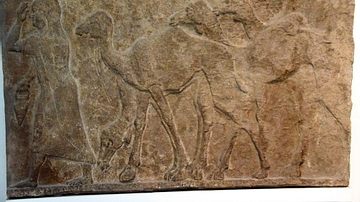
Captured Camels from Arab Enemies of Tiglath-pileser III
The woman on the left and the herd of camels behind her are part of a procession of prisoners and booty captured during one of the military campaigns of Tiglath-pileser III (reigned 744-727 BCE) against Arab enemies. Assyrian, about 728 BCE...

Image
King Tiglath-pileser III in a Ceremony
The Assyrian King Tiglath-pileser III (reigned 744-727 BCE) wears a ceremonial robe and holding a bow, once facing 2 high officials (no longer preserved but recorded in a drawing). Behind him, stands a beardless attendant holding a spear...

Article
History of Assyria
The foundation of the Assyrian dynasty can be traced to Zulilu, who is said to have lived after Bel-kap-kapu (c. 1900 BCE), the ancestor of Shalmaneser I. The city-state of Ashur rose to prominence in northern Mesopotamia, founding trade...

Definition
Sargon II
Sargon II (r. 722-705 BCE) was one of the most important kings of the Neo-Assyrian Empire as founder of the Sargonid Dynasty which would rule the empire for the next century until its fall. He was a great military leader, tactician, patron...
Image
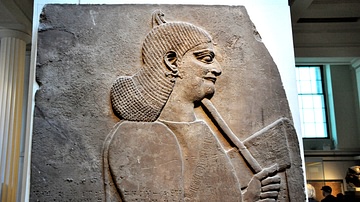
Arms-bearer of Tiglath-pileser III
This gypsum wall relief depicts a beardless man holding a bow and quiver; this is the "Keeper of the King's Bow". His earring has 3 knob-like projections. Neo-Assyrian Period, reign of Tiglath-pileser III, circa 728 BCE. From the Central...

Definition
Kalhu / Nimrud
Kalhu (also known as Caleh, Calah, and Nimrud, in modern-day northern Iraq) was a city in ancient Mesopotamia that became the capital of the Assyrian Empire under Ashurnasirpal II (r. 884-859 BCE) who moved the central government there from...
