
Search
Remove Ads
Advertisement
Search Results
Image
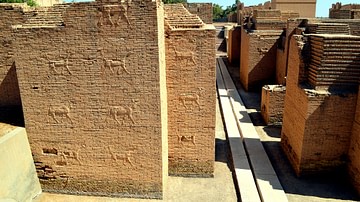
Part of the Processional Way at Babylon
This is part of the processional way (or street) at the ancient city of Babylon, in modern-day Iraq. The reliefs of aurochs (bulls) and mušḫuššus (dragons) are originals, as are the flanking walls. Neo-Babylonian...

Image
Camp Garnett, Part of the Battle of Rich Mountain
Camp Garnett, part of the Battle of Rich Mountain (11 July 1861) in the American Civil War, photograph by Brian M. Powell, Randolph County, West Virginia, 16 March 2006. This was the site of the camp...

Image
Part of an altar from Tel Halaf
These enamelled bricks formed part of an altar at the forecourt of the temple palace of Guzana (or Gozan). From Tell Halaf (modern Al-Hasaka Governorate), northeastern Syria. Neo-Assyrian period, circa 800 BCE. (The...

Definition
Veii
Veii (modern name: Isola Farnese, in Etruscan: Vei), was an important Etruscan town located near the west coast of central Italy. Lying just 16 km north of Rome, it was the most southerly of the major Etrurian settlements. The prosperity...

Image
Part of Tablet V, the Epic of Gilgamesh
A newly discovered partially broken tablet V of the Epic of Gilgamesh: "the episode of the journey of Gilgamesh and Enkidu." According to Professor Farouk Al-Rawi (of the School of Oriental and African Studies...
Image
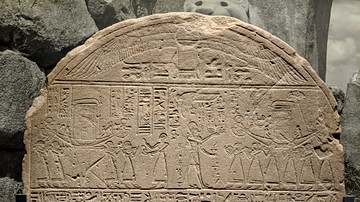
Bakhtan Stela (Upper Part)
This stela shows two symmetrical scenes. On the left, we see a priest offers incense to a barque carrying a statue of "Khonsou-Spellcaster-of-Thebes-and-Chaser-of-Demons". On the right, Ramesses II presents incense to...
Image
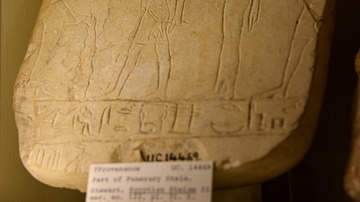
Part of a Funerary Stela
This is an almost square limestone stela with rounded corners. It is inscribed in hieroglyphs. On the left side, the stela depicts a standing woman (Tames); she uses an incense burner and pours a libation adjacent to a...

Image
Part of a Stelophosphorus Statue
The lower half of an unknown kneeling person has survived. The figure holds a stelophosphorus stela. From modern-day Egypt. New Kingdom, 18th Dynasty circa 1400 BCE. (State Museum of Egyptian Art, Munich, Germany).
Image
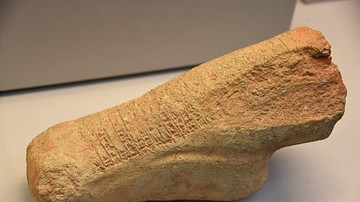
Inscribed Part of a Mesopotamian Hound
The hindquarters of a terracotta statue of a sitting dog. The inscription mentions that it was dedicated to the goddess of healing, Gula, by an official, Ninurta-Resushu, for his king Nazi-Maruttash. The goddess...
Image
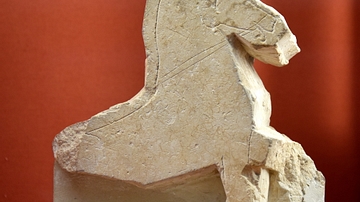
Part of an Unfinished Horse in Limestone
The outline is incised and then roughly cut round. A bridle is indicated and, on the extreme left, perhaps the knee of the rider. Presented by the Committee of the British School at Athens. Greek, about 500...
