
Search
Remove Ads
Advertisement
Search Results

Article
Jesus & the Law of Moses
New Testament studies now place Jesus Christ within the parameters of Second Temple Judaism in the 1st century CE, attempting to go behind the layers of later Christian theology and philosophy (such as the trinity) to understand how his message...
Image
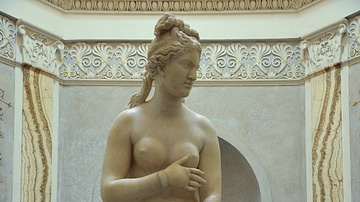
Capitoline Venus
The Capitoline Venus is a type of statue of Venus, specifically one of several Venus Pudica (modest Venus) types, of which several examples exist. The type ultimately derives from the Aphrodite of Cnidus. The so-called “Capitoline Venus”...
Image
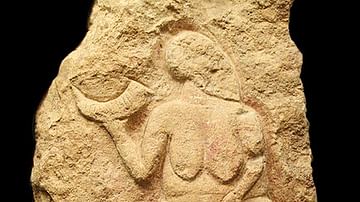
The Venus of Laussel
The Venus of Laussel, carved between 20,000 and 18,000 years ago, is a rare example of a pre-historic bas-relief. Her faceless, voluptuous figure is characteristic of the Venus figurines produced throughout Ice Age Europe. Many scholars believe...

Image
Mural of Cleopatra and Caesarion as Venus and Cupid
This mid-1st Century BCE mural portrays a statue of Venus and the infant Cupid in the Temple of Venus Genitrix, Rome. The statue has been identified as the infamous gilded statue of Cleopatra VII as Venus that Julius Caesar unveiled during...

Definition
Aeneas
In Greco-Roman mythology, Aeneas is a Trojan prince and the legendary founder of the Romans. He is the son of Anchises, a member of the Trojan royal family, and the goddess Aphrodite/Venus. Aeneas was one of the few Trojan heroes who escaped...

Definition
Karnak
Karnak is the modern-day name for the ancient site of the Temple of Amun at Thebes, Egypt. The Egyptians called the site Nesut-Towi, "Throne of the Two Lands", Ipet-Iset, "The Finest of Seats" as well as Ipt-Swt, "Selected Spot" also given...

Article
Sailing on Lake Nasser towards Abu Simbel
In ancient times, the First Cataract at Aswan marked the southern frontier of Egypt. Beyond lay the land of Nubia, which stretched along the river Nile from the First Cataract southwards for about 250 kilometres (155 mi). This region, known...

Image
Venus of Hohle Fels
Venus from Hohle Fels, carved from mammoth ivory in the Late- or Upper Paleolithic Aurignacian period and discovered near Schelklingen, Germany. It has been dated to c. 40,000 to c. 35,000 years old.
Image
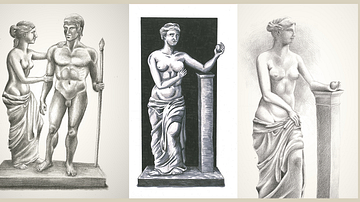
Impressions of the Venus of Milos
Artist impressions of the Vénus de Milo inspired by the reconstructions of Ravaisson (left) and Furtwängler (right).

Definition
Fire Temple
Fire Temples are places of worship in the Zoroastrian religion. They were known as ataskada (“house of fire”) by the Persians but are best known today by their Greek name pyratheia (fire temple). They are thought to have originated from the...
