
Search
Remove Ads
Advertisement
Search Results
Image
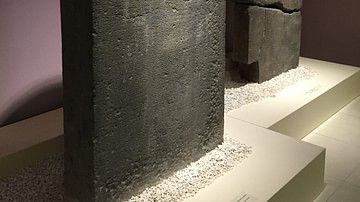
Tablets with King Nabonidus Inscriptions, Harran
These large tablets comes from the 6th-5th century BCE. They contain the inscriptions from King Nabonidus, who was the last king of the Neo-Babylonian Empire, reigning from 556–539 BC. These tablets were...
Image
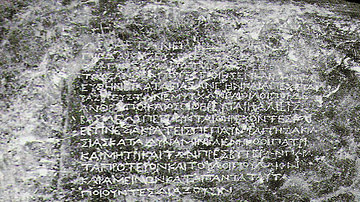
Greek and Aramaic inscriptions by king Ashoka
Bilingual (Greek and Aramaic) inscriptions by king Ashoka at Kandahar (Shar-i-kuna). (3rd century BCE). Preserved at Kabul Museum. Today disappeared. Two-dimensional inscription. Greek (transliteration...
Image
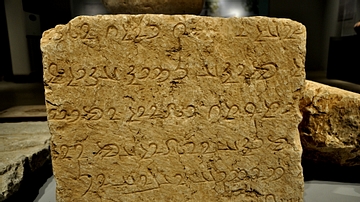
A stone with inscriptions from Paikuli Tower
The inscriptions on this stone mention the name of the Sassanian king Narseh and they were written in middle Persian and Parthian languages. Sassanid period, around 300 CE. From Paikuli tower, modern Sulaimaniya...
Image
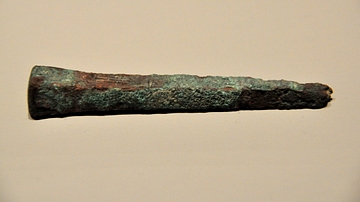
Akkadian Bronze Peg with Inscriptions
This is the oldest inscribed object among the Sulaimaniya Museum's collections. The cuneiform inscriptions can be seen on the upper surface of the peg. 3rd millennium BCE, Mesopotamia, Iraq. (The Sulaimaniya Museum...
Image
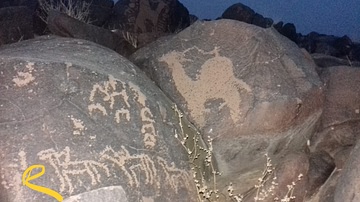
Safaitic Inscriptions, Jordan
Safaitic inscriptions on basalt rocks. 1st century BCE to 4th century CE. Jordan Desert or Al Harr’a.
Image
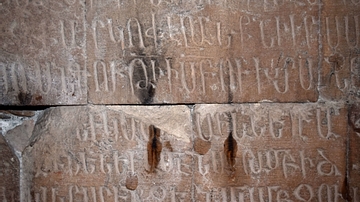
Armenian Inscriptions in Surb Karapet Church
These Armenian Inscriptions in Noravank Monastery's Surb Karapet Church date from the Middle Ages.
Image
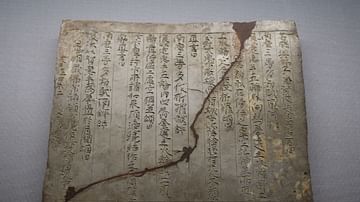
Japanese Tablet with Sutra Inscriptions
This clay tablet with sutra inscriptions was excavated at Komachizuka Sutra Mound in Tanga, which is located in Mie prefecture, Japan. It dates to 1174 CE (Jo'an 4). Important cultural property. (Tokyo National...

Image
A Stone Bowl with Two Inscriptions
This stone bowl has two sets of cuneiform inscriptions. The first one says that the bowl was booty brought to Mesopotamia from Magan (modern Sultanate of Oman) by the Akkadian king Naram-Sin (2254-2218 BCE). The...
Image
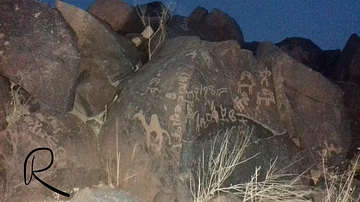
Safaitic Inscriptions in the Jordan Desert
Safaitic inscriptions on basalt rocks. 1st century BCE to 4th century CE. Jordan Desert or Al Harr’a.
Image
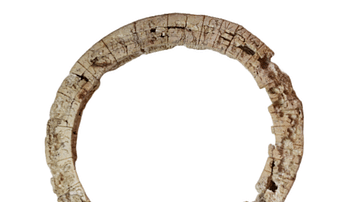
Minoan Ivory Sceptre Covered with Two Linear A Inscriptions
The Minoan ivory scepter discovered in Crete in 2024 is engraved with the longest Linear A inscription ever found. The inscription consists of approximately 119 signs covering the entire surface...
