
Search
Remove Ads
Advertisement
Search Results

Article
Sailing on Lake Nasser towards Abu Simbel
In ancient times, the First Cataract at Aswan marked the southern frontier of Egypt. Beyond lay the land of Nubia, which stretched along the river Nile from the First Cataract southwards for about 250 kilometres (155 mi). This region, known...
Image
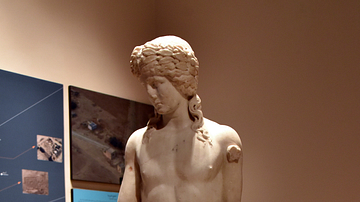
Marble Statue of Apollo from Samaria
Apollo was the god of music, light, truth, and healing in Graeco-Roman mythology, but this statue was found in a temple dedicated to "Kore", the goddess of the underworld and vegetation. The back of the statue was not polished, suggesting...

Definition
Midas - The Mythical King with the Golden Touch
Midas was a mythical king of Phrygia in Asia Minor who was famous for his extraordinary ability to change anything he touched into gold. This gift was given to him by Dionysos in thanks for his hospitality to the wise satyr Silenus. Midas...

Definition
Delos
Delos is a Greek island in the Cyclades archipelago which was both an influential political force and, with its sanctuary to the god Apollo, an important religious centre in the Archaic and Classical periods. The island was also a major commercial...
Article
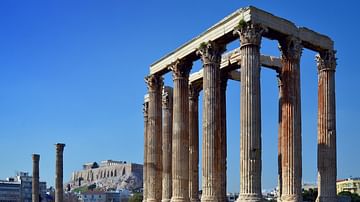
Temple of Olympian Zeus, Athens
The Temple of Olympian Zeus in Athens, also known as the Olympieion, was built over several centuries starting in 174 BCE and only finally completed by Roman emperor Hadrian in 131 CE. Its unusually tall columns and ambitious layout made...
Image
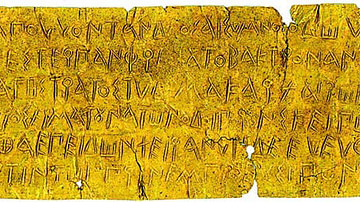
Greek Amulet Invoking Apollo
A beaten gold amulet stamped with a Greek text invoking the god Apollo. The text reads: INVOCATION TO THE GOD PHOEBUS APOLLO WHO RULES OVER MAN, POURING OUT LIBATIONS TO HIM, THAT HE MAY TAKE UP ARMS AND GO THROUGH THE ENEMY'S ARMY TO...
Definition
Lyre
The lyre was a stringed musical instrument played by the ancient Greeks. It was probably the most important and well-known instrument in the Greek world. The lyre was closely related to the other stringed instruments: the chelys which was...

Image
Apollo, Olympia
Marble statue (severe style) of Apollo (c. 460 BCE) from the west pediment of the temple of Zeus, Olympia (Olympia Archaeological Museum).
Image
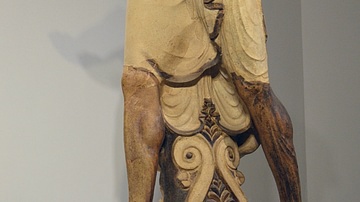
Apollo of Veii
Large scale terracotta sculpture depicting the Apollo of Veii (the Etruscan Aplu). From the roof of the Portonaccio Temple at Veii (Italy), around 510 BCE. (National Etruscan Museum of Villa Giulia, Rome)
Image
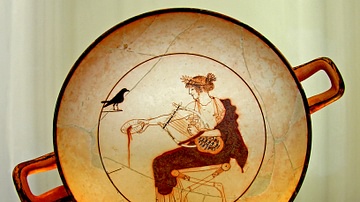
Apollo with Lyre
A kylix depicting the god Apollo pouring a libation and holding an early version of the lyre (chelys) which was made from the shell of a tortoise. The bird may represent the crow which announced the marriage of the nymph Aigle-Korone, the...
