
Search
Remove Ads
Advertisement

 This answer was generated by
 Search Results

Image
Taweret
Blue glazed steatite figure of Taweret from the Late Period of Ancient Egypt.
Image
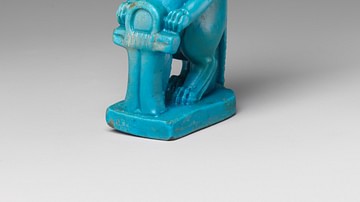
Faience Taweret Statue
A blue faience statue of the Egyptian goddess Taweret. 332-30 BCE. Near Qena, Egypt. (Metropolitan Museum of Art)

Article
Egyptian Gods - The Complete List
The gods and goddesses of Ancient Egypt were an integral part of the people's everyday lives for over 3,000 years. There were over 2,000 deities in the Egyptian pantheon, many whose names are well known - Isis, Osiris, Horus, Amun, Ra, Hathor...

Definition
Bes
Bes is the ancient Egyptian god of childbirth, fertility, sexuality, humor, and war, but served primarily as a protector god of pregnant women and children. He is regularly depicted as a dwarf with large ears, long-haired and bearded, with...

Article
The Magical Lullaby of Ancient Egypt
The Magical Lullaby (popularly known as Charm for the Protection of a Child) is an inscription from the 16th or 17th century BCE. The poem exemplifies the ancient Egyptian's personal religious and spiritual practices as it is a spell which...

Definition
Menes
Menes (c. 3150 BCE) is the legendary first king of Egypt who is thought to have united Upper and Lower Egypt through conquest and founded both the First Dynasty and the great city of Memphis. His name is known from sources such as Manetho's...
Article
Women's Work in Ancient Egypt
Women in ancient Egypt had greater rights than in any other civilization of the time. They could own land, initiate divorce, own and operate their own business, become scribes, priests, seers, dentists, and doctors. Although men were dominant...

Article
Twelve Menacing & Protective Mythological Figures
The term mythology comes from the Greek words mythos (“story of the people”) and logos (“word”) and so is defined as the spoken (later written) story of a culture. Modern scholars have divided myths into different types which serve many different...
Article
Family Planning in the Ancient Near East
The ancient Near East was home to a multitude of civilizations, across Egypt, Mesopotamia, and the Levant, each with unique views on medicine, conception, and women’s role in society. Attitudes towards contraception and abortion varied according...
