
Search

 This answer was generated by
 Search Results
Image
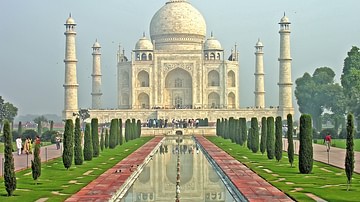
Taj Mahal
The Taj Mahal, Agra. Built in 1634 CE by Shah Jahan as a mausoleum for his favourite wife Mumtaz Mahall.

Article
Royal Women in the Mughal Empire
It was not only the Mughal emperors that left an indelible mark in the history of the Indian subcontinent but also the queens and princesses. The latter's contributions to art, architecture, literature, cuisine, refinement, and administrative...

Article
Mandu - City of Joy
The city of Mandu is situated about 35 km from Dhar in the Madhya Pradesh region of northern-central India. Most of the city's monuments date to the 15th and 16th century CE. The city is located on a hill which rises 633 m above the sea level...
Image
Mumtaz Mahal
A 19th-century illustration showing a seated Queen Mumtaz Mahal (1593-1631), wife of Shah Jahan (r. 1628-1658), emperor of the Mughal Empire. Shah Jahan famously built the Taj Mahal for Mumtaz Mahal.

Article
Mehrauli Archaeological Park
Mehrauli Archaeological Park is situated in Delhi, just beside the Qutb Complex (historically, Mehrauli was the first of the seven cities of Delhi). Spanning an area of more than 200 acres (80 ha), the site displays the rich heritage of India...
Image
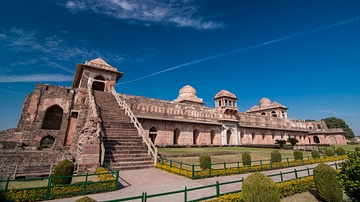
Jahaz Mahal, Mandu
The Jahaz Mahal (built in the late 15th Century CE) in Mandu, Madhya Pradesh.
Image
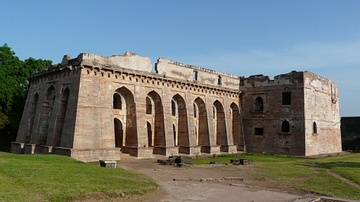
Hindola Mahal, Mandu
The Hindola Mahal, built c. 15th Century CE. Mandu, Madhya Pradesh.
Definition
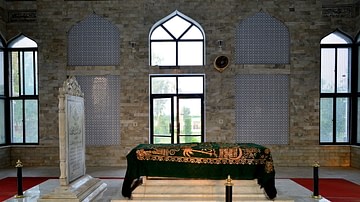
Muhammad Ghori
Shihab al-Din (also Muʿizz al-Din Muhammad ibn Sam), popularly known as Muhammad Ghori (r. 1173-1206 CE), was the Muslim ruler who laid the foundation for the subsequent Islamic ruling dynasties of India which saw its pinnacle later in the...
Definition
Upanishads
The Upanishads are the philosophical-religious texts of Hinduism (also known as Sanatan Dharma meaning “Eternal Order” or “Eternal Path”) which develop and explain the fundamental tenets of the religion. The name is translated as to “sit...

Article
The English and Dutch East India Companies' Invasions of India
In the early 17th century, the Dutch and English East India Companies turned their eyes towards India, as part of their grand schemes to develop extensive trade networks across the Indian and China Seas. They were faced with two significant...
