
Search
Did you mean: Agora?
Remove Ads
Advertisement
Search Results
Image
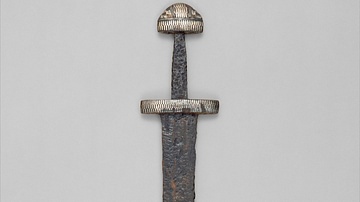
Viking Pattern-Welded Sword
A 10th Century CE steel sword, likely made in Scandinavia. The high quality of the pattern-welded steel blade, and beautiful decoration on the hilt, indicates that it was owned by a high status warrior. Steel blade, decorated...
Image
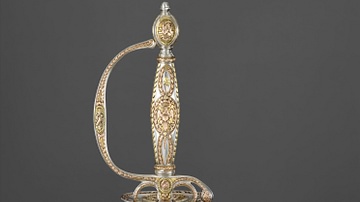
Continental Army Presentation Sword
A presentation sword awarded to Colonel Marinus Willett (1740–1830 CE), of the Continental Army. It is one of ten "elegant swords" awarded by the Continental Congress to officers who demonstrated exceptional merit...
Image
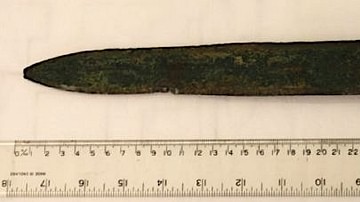
Eastern Zhou Dynasty Sword
A bronze sword from the Eastern Zhou dynasty, China, 5th-3rd century BCE. (British Museum, London)

Image
Abandoned Tank, Sword Beach
A photograph of an abandoned British flail tank on Sword Beach during the D-Day Normandy Landings of 6 June 1944. (Imperial War Museums)

Image
Mycenaean Sword
The gold revetment of a bronze Mycenaean sword. Grave Circle A, Mycenae, 16th century BCE. (National Archaeological Museum, Athens)

Image
British Commandos, Sword Beach
A photograph showing British commandos of the 1st Special Service Brigade attacking Sword Beach on D-Day 6 June 1944. The brigade was led by Lord Lovat (seen in the photo on the right of the column wading in the sea...
Image
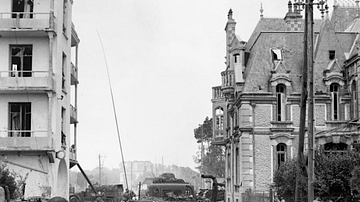
British Troops off Sword Beach
A photograph showing British troops moving inland off Sword Beach after the D-Day Normandy Landings of 6 June 1944. The town is La Brèche d'Hermanville. (Imperial War Museums)
Image
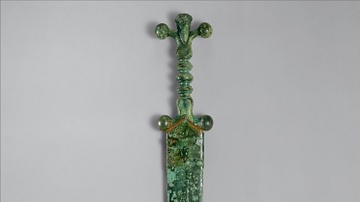
Anthropomorphic Celtic Sword
A Celtic sword and its scabbard (now amalgamated) from c. 60 BCE, associated with the La Tene culture. The sword's hilt is decorated with the head of a warrior, geometrically reduced like many other examples of Celtic...
Image
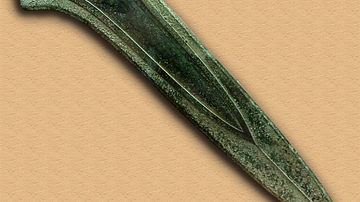
Bronze Age Sword
Ceremonial giant dirk of the Plougrescant-Ommerschans type, Plougrescant, France, 1500–1300 BC.

Image
Samurai Sword Handles
The handles of a pair of samurai swords (the daisho or 'great and small') with traditional ray skin covers and silk bindings. 19th century CE. (Metropolitan Museum of Art, New York)
