
Search
Remove Ads
Advertisement
Search Results

Image
Statue of Idrimi
Late Bronze Age / Syrian, 16th century BC From Tell Atchana (ancient Alalakh), modern Turkey A statue of a king of Alalakh, covered with his biography in cuneiform This extraordinary statue represents Idrimi, a king of Alalakh. It...
Image
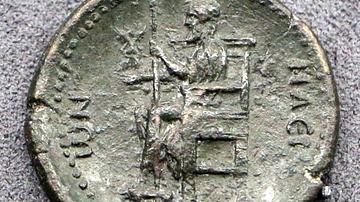
Statue of Zeus at Olympia on a Coin of Hadrian
A coin from the reign of Hadrian depicting the staute of Zeus at Olympia, on of the Seven Wonders of the World. 117-138 CE. (National Archaeological Museum, Florence)
Article
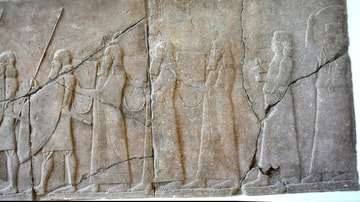
Festivals in Ancient Mesopotamia - Courting the Goodwill of the Gods
Festivals in ancient Mesopotamia honored the patron deity of a city-state or the primary god of the city that controlled a region or empire. The earliest, the Akitu festival, was first observed in Sumer in the Early Dynastic period (circa...

Article
Museums in the Ancient Mediterranean
Museums have been around much longer than one might think, but in the ancient world, they were principally institutions of research and learning rather than places to display artworks and artefacts, even if they were often located in grand...

Definition
Zeus
Zeus was the king of the 12 Olympian gods and the supreme god in Greek religion. Zeus is often referred to as the Father, as the god of thunder, and the 'cloud-gatherer'. Zeus controlled the weather and offered signs and omens. Zeus generally...

Definition
Ancient Greek Sculpture
The sculpture of ancient Greece from 800 to 300 BCE took inspiration from Egyptian and Near Eastern monumental art, and evolved into a uniquely Greek vision of the art form. Greek artists captured the human form in a way never before seen...

Image
Statue of Horus at Edfu
Statue of Horus, black granite statue. Temple of Edfu, Egypt, 07 September, 2025. A colossal 3.2 meters (10.50 ft) tall black granite statue of Horus as a falcon wearing the double crown (Upper and Lower Egypt) embodying the majesty of the...
Image
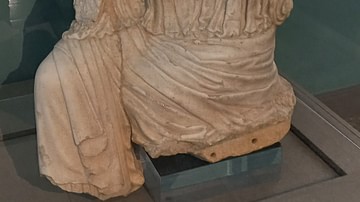
Statue of Penelope from Persepolis
Statue of Penelope, marble copy of the bronze original, found in Persepolis in 1936, dated to c. 450 BCE. National Museum of Iran, Tehran, acc. no. 1538 This marble torso of a seated woman in sophisticated drapes, with a height of 85 cm...
Image
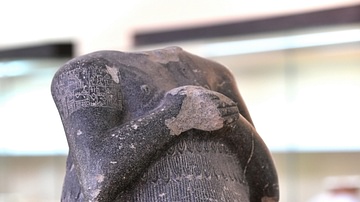
Headless Statue of Entemena of Lagash
This black diorite statue depictes Entemena, a king (or ruler) of Lagash, around 2400 BCE; identified by the cuneiform inscriptions on the right shoulder and back. The king wears the typical flounced Sumerian skirt. The statue was found in...
Image
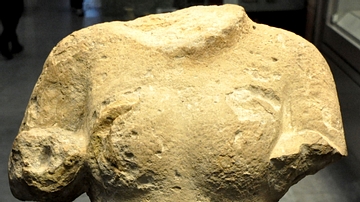
Statue of a Naked Woman from Nineveh
This limestone statue is the only discovered statue which depicts a completely naked woman. It is very likely that the statue represents an attendant of goddess Ishtar or Ishtar herself in her role as a goddess of love. The cuneiform inscriptions...
