
Search
Did you mean: Oenone?
Remove Ads
Advertisement
Search Results

Article
J. R. Giddings' Account of the Dade Massacre of the Second Seminole War
The Dade Massacre (also given as the Dade Battle, 28 December 1835) was the opening engagement of the Second Seminole War (1835-1842) between Euro-American forces and those of the Seminole, Black Seminole, and runaway slaves who had found...

Article
Second Battle of Newbury
The Second Battle of Newbury on 27 October 1644 was a major battle during the English Civil Wars (1642-1651). There was no clear winner despite the Parliamentarians having a numerical advantage of 2:1. The seeming lack of coordination between...

Image
Map of the Second Punic War (218 - 201 BCE) - Hannibal, Scipio, Rome, and the fall of Carthaginian power
The Second Punic War (218–201 BCE) was the decisive conflict between the Roman Republic and Carthage for dominance in the western Mediterranean. It grew out of Carthage’s recovery after the First Punic War (264–241 BCE), especially the Barcid...

Image
Division of the Second Triumvirate
A map showing the areas controlled by different members of Rome's Second Triumvirate of Lepidus (Brown), Octavian (Purple), and Mark Antony (Green) in the 1st century BCE. The light red areas indicate shared control.

Image
Map of the Second Anglo-Boer War, 1899–1902 - The Remaking of South Africa
The Second Anglo-Boer War (1899–1902) was a major conflict between the British Empire and the Boer republics of the South African Republic (Transvaal) and the Orange Free State, rooted in imperial rivalry, economic interests, and competing...

Image
Territories During the Second Punic War
The territories involved in the Second Punic War, 218 and 201 BCE.
Red = Roman
Pink = Roman Allies
Blue = Carthaginian
Light Blue = Carthaginian Allies

Image
Campaigns of the Second Punic War
A map illustrating the campaigns of the Second Punic War (218-201 BCE).

Image
The Second Crusaders Arrive in Constantinople
A 15th century CE painting by Jean Fouquet depicting the Second Crusaders (1147-49 CE), led by Louis VII and Conrad III, as they arrive at Constantinople.
Image
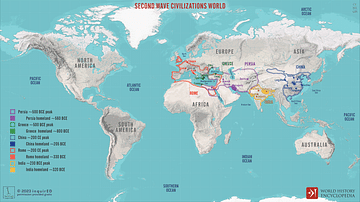
Second Wave Civilizations
A map illustrating the rise and spread of the Second Wave Civilizations between c. 500 BCE and 200 CE (including the Persians, the Greeks, the Romans, the Chinese, and India).
Image
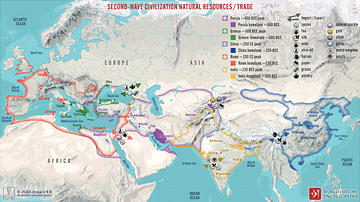
Second-Wave Civilization Natural Resources and Trade
A map illustrating the rise and spread of the Second Wave Civilizations between c. 500 BCE and 200 CE (including the Persians, the Greeks, the Romans, the Chinese, and India) with the flows of trade in major goods and resources.
