
Search
Did you mean: Samhain?
Remove Ads
Advertisement
Search Results

Definition
Wolof Empire
The Wolof (aka Jolof or Djolof) Empire was a state on the coast of West Africa, located between the Senegal and Gambia rivers, which thrived from the mid-14th to mid-16th century CE. The empire prospered on trade thanks to the two...

Image
Trans-Saharan Camel Caravan
A trans-Saharan camel caravan carrying salt. Agadez to Bilma, Niger.

Image
Camel Caravan, Morocco
A modern camel caravan in Morocco.

Definition
Berbers
The Berbers have occupied North Africa, specifically the Maghreb, since the beginning of recorded history and until the Islamic conquests of the 8th century CE constituted the dominant ethnic group in the Saharan region. Modern Berber...

Definition
Desert Rats - British Eighth Army's Elite Desert Troops
The Desert Rats was the nickname of the 7th Armoured Division of the British Eighth Army, which first fought in North Africa during the Second World War (1939-45). Fighting in the Western Desert...
Definition
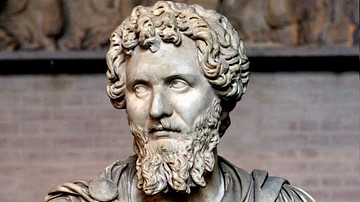
Septimius Severus
Lucius Septimius Severus was Roman emperor from April 193 to February 211 CE. He was of Libyan descent from Lepcis Magna and came from a locally prominent Punic family who had a history of rising to senatorial as well as consular...

Image
Camel Riders in the Desert
Artist's impression of camel riders in the desert. The camel was a common mode of transport in Africa and the Middle East during ancient, medieval and early modern times.

Definition
Juba II
Juba II (c. 48 BCE - 23 CE) was a Numidian prince and the king of Mauretania from c. 25 BCE until his death in 23 CE. He was raised in the household of Julius Caesar (c. 100-44 BCE) and married Cleopatra Selene II (40 - c. 17/5 BCE...
Article
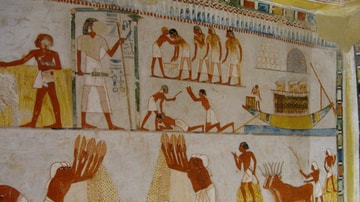
Social Structure in Ancient Egypt
The society of ancient Egypt was strictly divided into a hierarchy with the king at the top and then his vizier, the members of his court, priests and scribes, regional governors (eventually called 'nomarchs'), the...

Article
Carthaginian Trade
The Carthaginians, like their Phoenician forefathers, were highly successful traders who sailed the Mediterranean with their goods, and such was their success that Carthage became the richest city in the ancient world. Metals...
