
Search
Search Results

Image
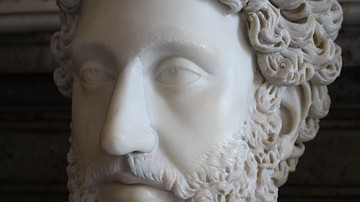
Roman Emperor Diocletian
Head of the Roman emperor Diocletian, 284 - 305 CE (Istanbul Archaeology Museum).
Definition
Diocletian
Diocletian was Roman emperor from 284 to 305 CE. After the defeat and death of the Roman emperor Philip the Arab in 249 CE, the empire endured over three decades of ineffective rulers. The glory days of Augustus, Vespasian, and Trajan were...
Definition
Roman Emperor
Roman emperors ruled the Roman Empire starting with Augustus in 27 BCE and continuing in the West until the late 5th century CE and in the Eastern Roman Empire up to the mid-15th century CE. The emperors took titles such as Caesar and Imperator...

Definition
Chinese Emperor
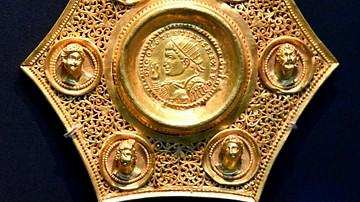
The emperors of ancient China had tremendous power and responsibility. Called the 'Son of Heaven', he (and once she) was given a divine right to rule over all people but was expected to promote their best interest and not his own. An absolute...
Article
Government and Taxes under Diocletian and Constantine
The state created by Diocletian and Constantine used to be described as despotic and oppressive, extracting higher taxes and threatening its subjects with punishments for non-compliance. Recent research, however, paints a different picture...

Definition
Western Roman Empire
The Western Roman Empire is the modern-day term for the western half of the Roman Empire after it was divided in two by the emperor Diocletian (r. 284-305 CE) in c. 285/286 CE. The Romans themselves did not use this term. At its height (c...

Definition
Roman Empire
The Roman Empire, at its height (c. 117), was the most extensive political and social structure in western civilization. Building upon the foundation laid by the Roman Republic, the empire became the largest and most powerful political and...

Definition
Byzantine Emperor
The Byzantine Emperor ruled as an absolute monarch in an institution which lasted from the 4th to 15th century CE. Aided by ministers, high-ranking nobility, and key church figures, the emperor (and sometimes empress) was commander-in-chief...

Definition
Emperor of Japan
The emperor of Japan is a position as the head of state which traditionally dates back to the 7th century BCE and the legendary figure of Emperor Jimmu (r. 660-585 BCE). Emperors came to be known as the Tenno or 'heavenly sovereign' in reference...

Definition
Yongle Emperor
The Yongle Emperor (aka Chengzu or Yung Lo, r. 1403-1424 CE) was the third ruler of the Chinese Ming Dynasty (1368-1644 CE). Inheriting a stable state thanks to the work of his father, the Hongwu Emperor (r. 1368-1398 CE), Yongle made lasting...
