
Search
Search Results
Image
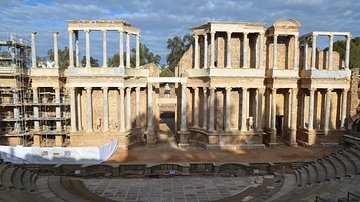
Roman Theatre of Augusta Emerita (Mérida, Spain)
The Roman theatre of Augusta Emerita is the most important Roman monument in Mérida (Spain) and the best example of its kind to be found in western Europe. Its construction began c. 15 BCE and an inscription indicates that Roman consul Marcus...
Image
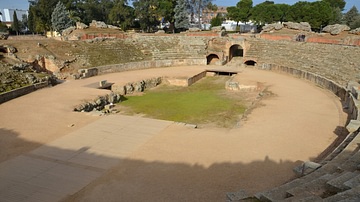
Roman Amphitheatre of Augusta Emerita (Mérida, Spain)
The amphitheatre of Augusta Emerita (modern-day Mérida, Spain) was construced in 8 BCE for use in gladiatorial contests and staged beast-hunts. It had a capacity of up to 15,000 people. The elliptical building was of considerable dimentions...
Image
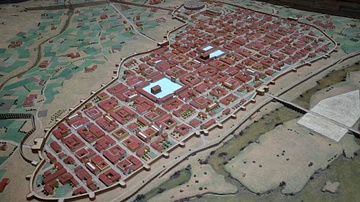
Scale Model of Augusta Emerita (Mérida, Spain)
Augusta Emerita (modern-day Mérida in Spain) was a Roman colony established by Augustus in 25 BCE. The city was the capital of the Roman province of Lusitania, and was one of the largest in Hispania with an area of over 20,000 square kilometres...
Image
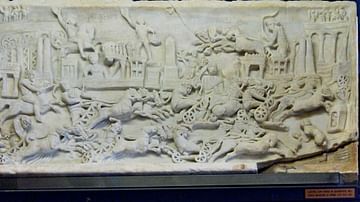
Roman Quadriga Race in the Circus Maximus
A releif showing a quadriga race in the Cricus Maximus, Rome (2-3rd century); Trinci Palace, Foligno, Italy. The starting gates can be seen on the far left. The upper left-hand corner shows the magistrate who will begin the race by dropping...

Image
Circus Maximus Reconstruction
An illustration of what the Circus Maximus chariot track of Rome might have looked like. The Circus Maximus dates back to the 6th century BCE but was at its most splendid in the 1st century CE when it had a capacity for 250,000 spectators...
Image
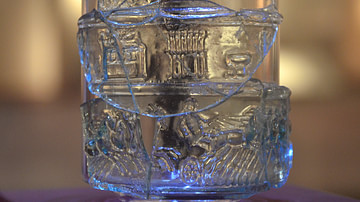
Beaker with Circus Scene
Fragmented mould-blown beaker with a circus scene and the inscription 'vade Pyramus' (meaning 'go Pyramus!'), a renowned charioteer from Pompeii. It also shows the spina (central barrier) of the Circus Maximus in the middle band. Below the...

Definition
Roman Architecture
Roman architecture continued the legacy left by Greek architects and the established architectural orders, especially the Corinthian. The Romans were also innovators and they combined new construction techniques and materials with creative...

Article
A Roman Trail in the Moselle Valley
The Moselle Valley is Germany's oldest winegrowing region. The Romans brought viticulture to this area and planted vines along the Moselle River 2000 years ago. After settling the region c. 50 BCE and establishing the city of Trier (Augusta...
![Circus Maximus [Present Day]](https://www.worldhistory.org/img/c/p/360x202/1276.jpg?v=1718938028)
Image
Circus Maximus [Present Day]
The view of Rome's Circus Maximus in the present day. The original circus lies 9 m below ground level and was first laid out in the 6th century BCE. The present site was remodelled in the 1930s CE to resemble the original.
Image
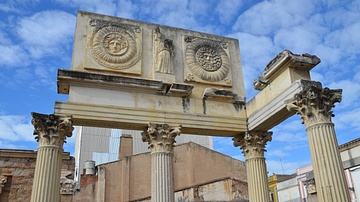
Portico in Augusta Emerita (Mérida, Spain)
A reconstructed Roman portico decorated with clipei (circular medallions) depicting Jupiter Ammon and Medusa. The structure was part of the Roman Forum in the town of Augusta Emerita (Mérida, Spain).
