
Search
Remove Ads
Advertisement
Search Results

Definition
Roman Art
The Romans controlled such a vast empire for so long a period that a summary of the art produced in that time can only be a brief and selective one. Perhaps, though, the greatest points of distinction for Roman art are its very diversity...

Definition
Roman Gladiator
A Roman gladiator was an ancient professional fighter who usually specialised with particular weapons and types of armour. They fought before the public in hugely popular organised games held in large purpose-built arenas throughout...
Image
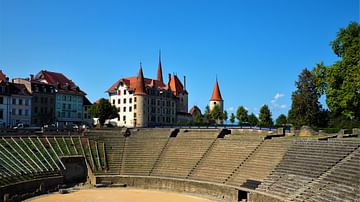
Avenches Amphitheatre
Roman amphitheatre of Avenches, Switzerland, built in the early 2nd century CE, in use until the 4th century CE, used as a stone quarry afterwards. In the 11th century, a fortified tower was built on its eastern entrance and...
Image
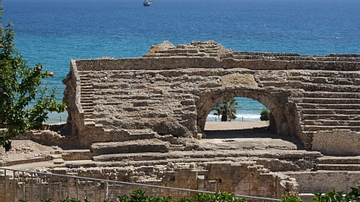
Amphitheatre of Tarragona
A section of the seating in the Roman amphitheatre of ancient Tarraco (Tarragona, Spain). 2nd century CE.
Image
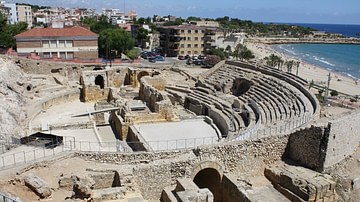
Tarraco Amphitheatre
The Roman amphitheatre of ancient Tarraco (Tarragona, Spain). 2nd century CE.
Image
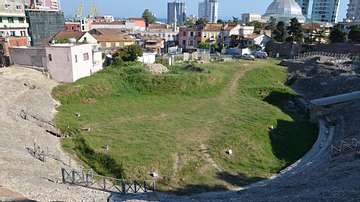
Amphitheatre of Durrës (Dyrrachium)
The Amphitheatre of Durrës (Roman Dyrrachium) in Albania was built in the 2nd century CE and held 15,000 to 20,000 people. It is among the largest monuments of antiquity to have survived on Albanian territory.
Image
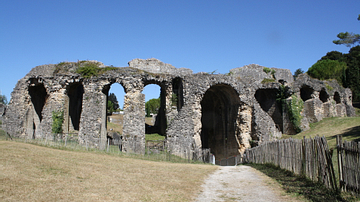
Amphitheatre Exterior, Mediolanum Santonum
The exterior of the Roman amphitheatre of Mediolanum Santonum (Saintes, Charente-Maritime), France. The arena could hold 15,000 spectators and was built 40-50 CE.

Image
Fresco Showing the Riot of 59 CE in the Amphitheatre of Pompeii
Fourth Style fresco depicting a riot that broke out in Pompeii in 59 CE during games held in the arena involving Pompeians and inhabitants of Nuceria. On the orders of Nero, this event led...

Image
Amphitheatre, Salona
The remains of the amphitheatre of Salona (Solin, Croatia), erected in the latter half of the 2nd century (c. 170 CE). The fights in the arena could be watched by some 17,000 spectators.
Image
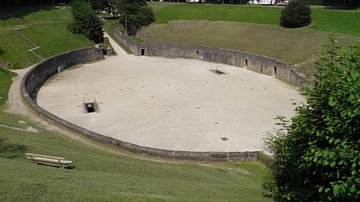
Trier Amphitheatre
The Trier amphitheatre was built towards the end of the 2nd century CE, and is part of the UNESCO World Heritage Site. It is estimated that it once held up to 18,000 spectators for gladiator tournaments and animal fights. The...
