
Search
Remove Ads
Advertisement
Search Results
Definition
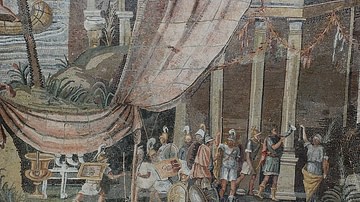
Ptolemaic Army
The army of Ptolemaic Egypt was a well-organized fighting force trained in Hellenistic warfare. The Ptolemaic dynasty used their considerable wealth to maintain a large standing army of professional soldiers. Some troops were paid in money...

Article
Astronomy in the Scientific Revolution
The astronomers of the Scientific Revolution rejected long-held theories of ancient thinkers like Claudius Ptolemy and Aristotle and instead set out to systematically observe the heavens in order to create a model of the universe that fit...
Definition
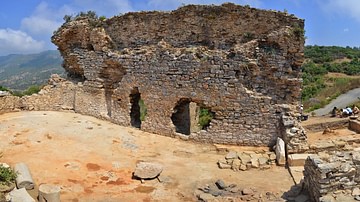
Antiochia ad Cragum
Antiochia ad Cragum (“Antioch on the Cliffs” or “Antioch at Cragus”) was a Hellenistic Roman city located in Cilicia Trachea (“Rough Cilicia”, also known as Cilicia Aspera and Cilicia Secunda) on the southern coast of modern-day Turkey (in...
Article
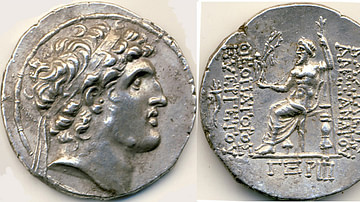
Alexandros I Balas
Alexandros I Balas was a Seleucid king from 152 BC to 145 BCE. As the Seleucid king Demetrius I Soter (162-150 BCE) became more and more unpopular due to his arrogance and drunkenness, it was quite an easy task for the rival kingdoms, such...

Definition
Cassander
Cassander (c. 355-297 BCE, r. 305-297 BCE) was self-proclaimed king of Macedon during the political turmoil following Alexander's death. Born in Greece as the son of Antipater, the regent of Macedon and Greece in the absence of Alexander...

Definition
Apis
Apis was the most important and highly regarded bull deity of ancient Egypt. His original name in Egyptian was Api, Hapi, or Hep; Apis is the Greek name. He is not, however, associated with the god Hapi/Hep who was linked to the inundation...

Definition
Ergamenes
King Ergamenes (also known as King Arkamani I, r. 295-275 BCE) was the greatest king of the city of Meroe, Kingdom of Kush (located in modern-day Sudan) who broke free from Egyptian dominance to help direct a wholly distinct culture. The...

Definition
Alexander Helios
Alexander Helios (40 BCE – c. late 1st century BCE) was a member of the Ptolemaic dynasty, the second oldest son of Cleopatra VII (69 BCE – 30 BCE) and the twin brother of Cleopatra Selene II (40 BCE – 5 BCE). He spent the majority of his...

Article
The Battle of Actium: Birth of an Empire
The battle of Cynoscephalae in 197 BCE concluded the Second Macedonian War (200-197 BCE) and consolidated Rome's power in the Mediterranean, finally resulting in Greece becoming a province of Rome in 146 BCE. This engagement is sometimes...
Article
Cleopatra & Antony
Regarded by the Romans as "fatale monstrum" – a fatal omen – Cleopatra is one of the ancient world's most popular, though elusive figures. The Egyptian queen has been immortalized by numerous writers and filmmakers, most popularly by William...
