
Search
Remove Ads
Advertisement
Search Results

Definition
Thales of Miletus
Thales of Miletus (l. c. 585 BCE) is regarded as the first Western philosopher and mathematician. He was born and lived in Miletus, a Greek colony in Ionia (modern Turkey) referenced as the birthplace of Greek Philosophy because of his high...

Definition
Orpheus
Orpheus is a figure from ancient Greek mythology, most famous for his virtuoso ability in playing the lyre or kithara. His music could charm the wild animals of the forest, and even streams would pause and trees bend a little closer to hear...

Article
The Thermometer & the Scientific Revolution
The thermometer was invented in the mid-17th century during the Scientific Revolution when scientists began to search for an accurate instrument to measure a wide range of temperatures using a scale that could be compared with other readings...

Article
Thucydides on the Plague of Athens: Text & Commentary
The Plague of Athens (429-426 BCE) struck the city, most likely, in 430 BCE before it was recognized as an epidemic and, before it was done, had claimed between 75,000-100,000 lives. Modern-day scholars believe it was most likely an outbreak...

Article
Gorgias' On Nature (On the Non-Existent)
Gorgias of Leontini (l. c. 427 BCE) was a famous Greek Sophist who claimed that nothing exists and, even if it does, its nature cannot be understood and, even if it could be, one is not able to communicate that understanding to another person...
Image
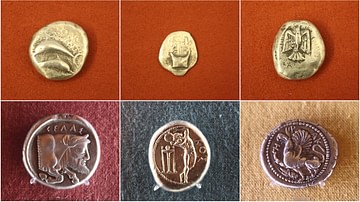
Ancient Greek Coins
Top row (L to R): Thera (c. 500 BCE) - Silver stater, two dolphins. Delos (6th century BCE) - Silver drachm, lyre. Siphnos (540-500 BCE) - Silver stater, eagle. (Alpha Bank Numismatics Museum, Kerkyra, Corfu) Bottom row (L to R...

Image
The Seven Sages of Ancient Greece
The Seven Sages (ΟΙ ΕΠΤΑ ΣΟΦΟΙ) of ancient Greece were renowned philosophers, statesmen, and lawgivers celebrated for their wisdom and practical contributions. First explicitly listed in Plato’s Protagoras, they were recognized as "the wise...
