
Search
Did you mean: Horace?
Remove Ads
Advertisement
Search Results
Definition
Ino
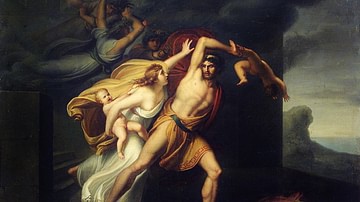
Ino is a princess of Thebes and the wife of King Athamas of Boeotia in Greek mythology. She helped to raise Dionysos, the god of wine, but the most famous myth associated with her is her descent into madness and the tragic fate of her family...

Definition
Oedipus at Colonus
Oedipus at Colonus was the third play of the Oedipus trilogy written by the great Greek tragedian Sophocles (c. 496 - c. 406 BCE). Although written in the years prior to his death, it would finally be presented by his son Iophon...

Definition
Boreas
Boreas is the god of the violent North Wind in Greek mythology. He is the son of the Titan Astraeus and Eos, the goddess of the dawn, and brother to Zephyrus (the West Wind) and Notus (the South Wind). He is best known for his bad temper...

Definition
Andromache
Andromache is a Greek tragedy written by Euripides (c. 484-407 BCE), one of only 19 plays (out of 92) to survive. The play is actually in two parts, and like Sophocles' Women of Trachis, it has no central character. The first part...

Definition
Nemea
Nemea was a religious sanctuary in the northern Peloponnese of Greece where pan-Hellenic athletic games were held every two years from 573 BCE until 271 BCE, after which, the Games were definitively moved to Argos. Early Settlement...

Definition
Women of Trachis
Women of Trachis is a Greek tragedy, one of Sophocles' (c. 496 BCE - c. 406 BCE) lesser-known works, the only one that does not deal with the aftermath of the Trojan War, rather it is concerned with the death of the Greek hero...

Definition
Cyclops (Play)
The satyr-play The Cyclops was written by Euripides, one of the great Greek tragedians, in 412 or 408 BCE. Like many of his fellow tragedians, Euripides centers his play on a well-known story from Greek mythology. The Cyclops is...

Article
The Life of Hercules in Myth & Legend
Hercules is the Roman name for the Greek hero Herakles, the most popular figure from ancient Greek mythology. Hercules was the son of Zeus, king of the gods, and the mortal woman Alcmene. Zeus, who was always...

Article
Kesh Temple Hymn - The Oldest Work of Religious Literature in the World
The Kesh Temple Hymn (circa 2600 BCE) is the oldest work of religious literature in the world, sometimes referenced as the oldest extant religious poem. It is a Sumerian praise song...
Article
The Importance of the Lydian Stater as the World's First Coin
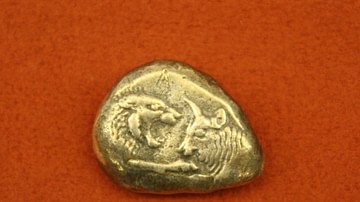
The Lydian Stater was the official coin of the Lydian Empire, introduced before the kingdom fell to the Persian Empire. The earliest staters are believed to date to around the second half of...
