
Search
Did you mean: Nile?
Search Results
Image
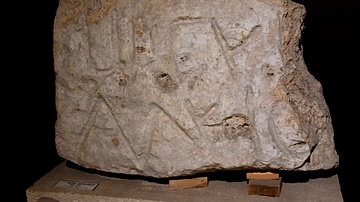
Inscription Bearing the Name of Alkios
This is a fragment of a boundary description, which mentions the name of the Governor Alkios. Limestone. Roman Period, 1st century CE. From Gezer (Tell el-Jezer), in modern-day State of Israel. (Museum of Archaeology, Istanbul, Turkey).
Image
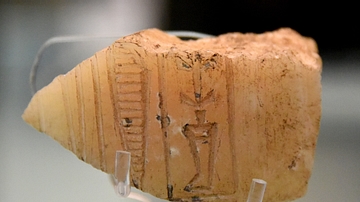
Fragment of Stone Jar Inscribed with the Name of Rimush
This small fragment came from a large upright stone jar. The jar was inscribed with the name of the Akkadian king Rimush, son of Sargon. Akkadian Period, reign of Rimush, 2278-2270 BCE. From Ur, Southern Mesopotamia, modern-day Iraq. (The...
Image
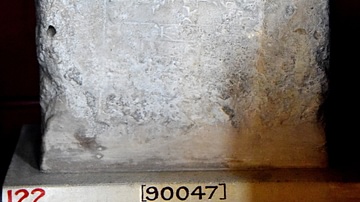
Mud Brick Stamped with the Name of Warad-Sin
This baked-mud brick was stamped with the name of king Warad-Sin, king of Larsa; reigned 1770-1758 BCE (short chronology) and possible co-regency with his father Kudur-Mabuk. The cuneiform inscriptions mention the building of the temple of...
Image
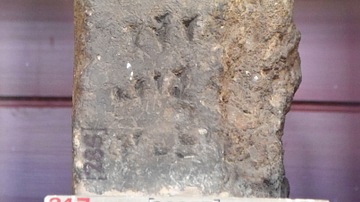
Brick Inscribed with the Name of Shalmaneser III
This cuneiform inscription on this fragment of a large brick mentions the name of the Neo-Assyrian king Shalmaneser III, reigned 858-824 BCE, and the construction of a temple at the city of Nimrud (ancient Kalhu; Biblical Calah). From Nimrud...

Image
Calligraphic Representation of Husayn's Name
An adapted version of the calligraphic pane of Husayn ibn Ali in the Hagia Sophia, Istanbul.
Image
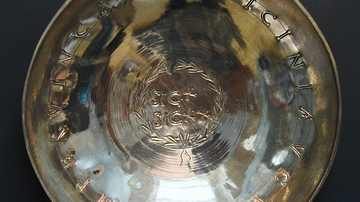
Silver Largitio Dish with the Name of Licinius
This object is associated with a late Roman emperor, who was at the heart of the changing Roman Empire. This silver dish names Licinius in its Latin inscription. Licinius co-ruled with Constantine the Great during early 300s, but their collaboration...

Article
The Ancient Celtic Pantheon
The ancient Celtic pantheon consisted of over 400 gods and goddesses who represented everything from rivers to warfare. With perhaps the exception of Lugh, the Celtic gods were not universally worshipped across Iron Age Europe but were very...

Video
New Name: World History Encyclopedia!
We have some really exciting things happening, and the biggest one is our new name: World History Encyclopedia. We have covered much of the ancient world, and are now working on Medieval, Renaissance, Early Modern Europe and Colonial so it...

Video
The Fascinating Story of How the Bowie Knife Got Its Name
Check my other channel Biographics! https://www.youtube.com/channel/UClnDI2sdehVm1zm_LmUHsjQ →Some of our favorites: https://www.youtube.com/playlist?list=PLR0XuDegDqP10d4vrztQ0fVzNnTiQBEAA →Subscribe for new videos every day! https://www.youtube.com/user/TodayIFoundOut?sub_confirmation=1...

Video
Curating Celts: What's in a Name?
You thought Celts were bright blue, marauding warriors who lived in mud huts? Not quite. Curator Julia Farley tackles the idea of what it means to be ‘Celtic’ in the British Museum exhibition:Celts: art and identity.
