
Search
Remove Ads
Advertisement
Search Results
Image
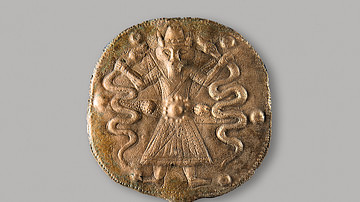
Bronze Hairpin Depicting 'Master of Animals' from Iron Age Zagros
Bronze Hairpin Depicting 'Master of Animals', found in Luristan (central Zagros), c. 950 to c. 650 BCE. National Museum of Iran, Tehran, acc. no. 1459. Photo by Neda Tehrani (Baloot Noghrei...
Image
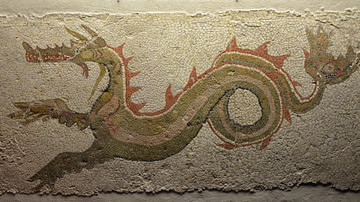
Sea Monster Ketos (Cetus)
Mosaic with a ketos (sea monster - Latinized as cetus) found at Caulonia (Monasterace) in the Casa del Drago, 3rd century BCE. Photo taken at the "Monsters. Fantastic Creatures of Fear and Myth" exhibition, Palazzo Massimo...
Image
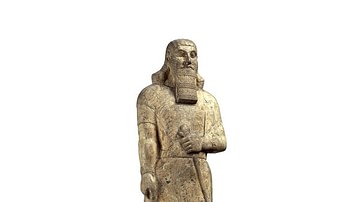
Statue of Ashurnasirpal II
Statue of Ashurnasirpal II from Nimrud (ancient Kalhu), modern-day northern Iraq, Neo-Assyrian Empire, 883-859 BCE. This statue of King Ashurnasirpal II (883-859 BCE) was placed in the Temple of Ishtar Sharrat-niphi...
Image
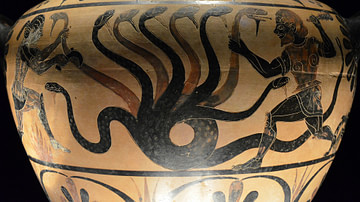
The Lernaean Hydra & Hercules
Hydria (ceramic water container) with Hercules and the Lernaean Hydra (an ancient serpent-like water monster), from Etruria, attributed to the Painter of Aquila, 530-500 BCE. Photo taken at the "Monsters. Fantastic...
Image
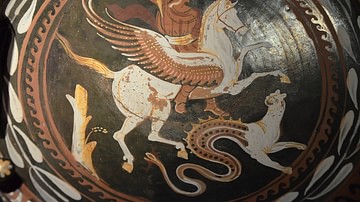
Bellerophon riding Pegasus and the Chimera
Red-figure plate showing Bellerophon riding Pegasus and chasing the Chimera, by the Baltimore painter, second half of the 4th century BCE. (Photo taken at the "Monsters. Fantastic Creatures of Fear and Myth"...
Image
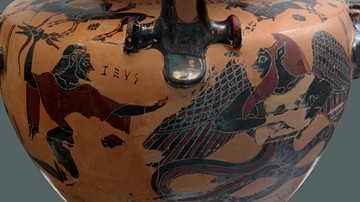
Zeus Aiming His Lighting Bolt at Typhon
Black-figure Chalcidian hydria, depicting Zeus, the king of the gods on the left, aiming his lightning bolt at Typhon, the father of monsters on the right, dated between 540-530 BCE. State Collections of Antiquities...
Image
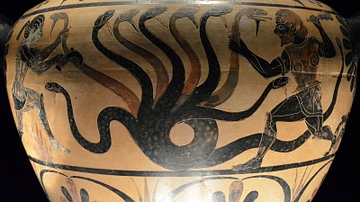
Herakles & the Lernaean Hydra
Hydria (ceramic water container) depicting Heracles killing the Lernaean Hydra (an ancient serpent-like water monster), from Etruria, attributed to the Painter of Aquila, 530-500 BCE. (photo taken at the Monsters. Fantastic...
Image
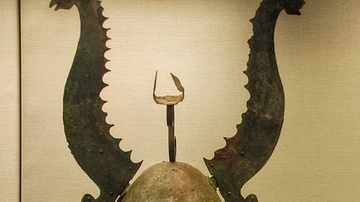
Sea-Monster Helmet
This bronze helmet has a crest with detachable horns shaped like horse-headed sea-monsters. The origin is unclear, it is perhaps a Messapian helmet from southern Italy. Circa 325-275 BCE. Castellani Collection, Bronze 2824...
Image
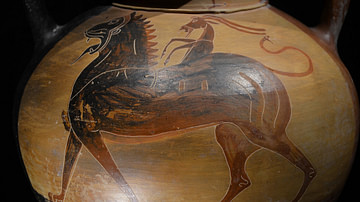
Chimera, Black-Figure Amphora
The Chimera on black-figured amphora, from southern Etruria, 550-525 BCE.
Photo taken at the "Monsters. Fantastic Creatures of Fear and Myth" exhibition, Palazzo Massimo alle Terme, Rome, in 2014.
Image
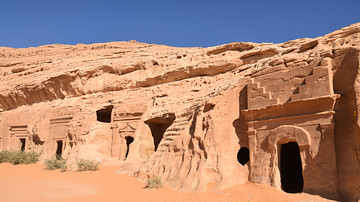
Qasr al-Bint Necropolis in Hegra
The Qasr al-Bint necropolis in Hegra (Mada'in Salih) in modern-day Saudi Arabia is one of the four necropolis areas to have survived. Qasr al-Bint consists of 31 Nabatean tombs dating from 1 to 58 CE. The tombs include...
