
Search
Remove Ads
Advertisement
Search Results

Image
Champollion's notes from the Rosetta Stone
This is a copy of the Rosetta Stone with some hand notes made by Jean-François Champollion.
This photo was taken at the Neues Museum, Berlim.
Image
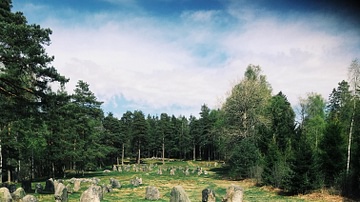
Stone Circles at The Hunnfelt
View of the nine stone circles at The Hunnfelt in Østfold, Norway. Dating from c. 500 BCE to c. 900 CE.

Definition
Barnhouse Settlement
The Barnhouse Settlement is a Neolithic village located in Antaness, Orkney, Scotland, which was inhabited between c. 3300 and 2600 BCE. The present designation of 'Barnhouse' comes from the name of the farmland on which the...

Image
Powhatan Stone
The Powhatan Stone, a historical marker erected by the Association for the Preservation of Virginia Antiquities in Chimborazo Park, Richmond, Virginia, USA. It was placed by the Mayo family of Richmond who once owned the property...
Definition
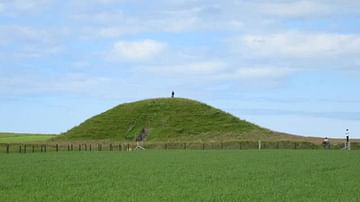
Maeshowe - The Ancient Meadow Mound of Orkney
Maeshowe (pronounced `maze-ow' or `maze-oo') is a large Neolithic chambered cairn, dating from between 3000-2800 BCE, in the Stenness parish of Orkney, Scotland. According to Dr. Berit Sandnes, of Lund University...
Image
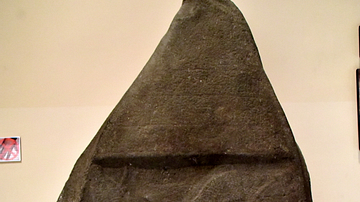
Al-Balu' Stele
Al-Balu's stele is a Moabite document. This stele found in Al-Balu'a, north of Kark, in 1930 CE contains an illegible hieroglyphic inscription. There are three figures depicted on the stele, which may represent a king and two deities...

Image
The Snaptun Stone
The Viking Age Snaptun stone was carved around 1000 CE and shows a face with stitched-up lips, which reminds of a story preserved in the Prose Edda where the Norse god's Loki’s lips are sewn up. As such, it is usually thought...
Image
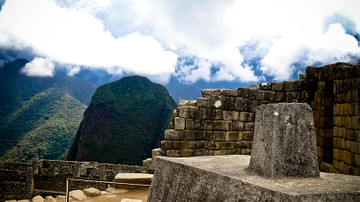
Intihuatana Stone, Machu Picchu
The Intihuatana Stone or 'Hitching Post of the Sun' at Machu Picchu in the High Andes. The stone was used by Inca priests for astronomical observations, especially of the sun. In ceremonies during the solstices the...

Image
Inca 12 Angle Stone
The famous stone from an Inca wall in Cuzco, Peru. The stone has 12 angles and illustrates the great precision Inca masons employed in ensuring their stone blocks fitted so well together that no mortar was needed. (15th century...
Image
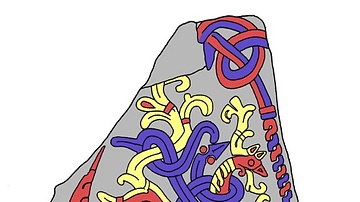
The Jelling Stone's Great Beast (Mammen Style)
Image showing one face of the Viking Age Jelling stone (standing at Jelling, Denmark) dating to c. 970 CE. The stone's three sides are covered, on one side with an inscription and on its other two with...
