
Search
Remove Ads
Advertisement
Search Results

Article
The Extent of the Roman Empire
Time has seen the rise and fall of a number of great empires - the Babylonian, the Assyrian, the Egyptian, and lastly, the Persian. Regardless of the size or skill of their army or the capabilities of their leaders...

Image
The Kingdom of Pontus
Map of the Pontic Kingdom before the reign of Mithridates VI (darkest purple), after his conquests (purple), and his conquests in the first Mithridatic wars (pink); little adds (ancient shorelines & some greek colonies under...
Image
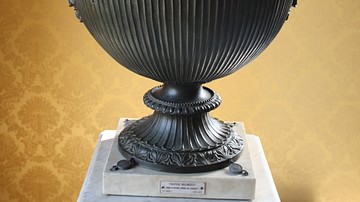
Crater of Mithridates Eupator
The bronze vessel known as the Crater of Mithridates Eupator. Found in Nero's villa, Rome. The inscription on the vase records the name Mithridates VI, king of Pontus (163-120 BCE). The vase was taken to Rome as war...
Image
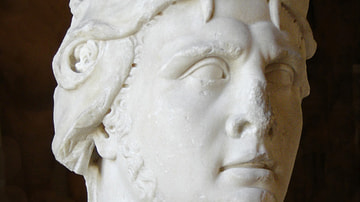
Mithridates VI
Mithridates VI ruled Pontus and Armenia minor 120-63 BCE. Here, he is depicted as Heracles wearing the skin of the Nemean Lion. (Louvre Museum, Paris)

Image
Mithridates VI Eupator of Pontus
Mithridates VI Eupator, king of Pontus (120–63 BCE), as Heracles, 1st century CE, Louvre Museum

Image
Mithridates Silver Tetradrachm
Silver tetradrachm from Pontus, reign of Mithridates VI Eupator, 120-63 BCE. O: Head of Mithridates. R: Stag.
Image
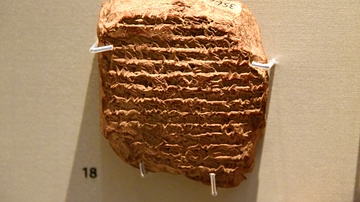
Tablet with Hellenistic King List
Written in Babylonian in the cuneiform inscription, this tablet lists the names and dates of several Seleucid kings. After Alexander's death, the Persian Empire fractured. Mesopotamia and Syria became part of the...
Image
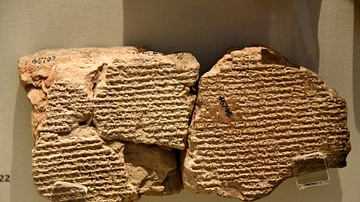
Tablet Describing Parthian Conquest of Babylonia
This tablet is written in cuneiform inscription and refers to the defeat of the Seleucid king Demetrius II Nicator by the Parthian ruler Mithradates I in 141 BCE. The Parthian ruler is referred to as...
