
Search
Did you mean: Mesopotamia?
Remove Ads
Advertisement
Search Results
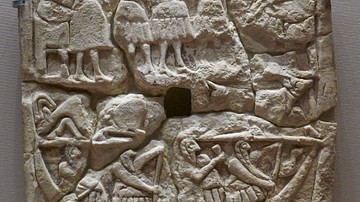
Image
Mesopotamian Banquet Scene
Perforated votive plaque with a banquet scene, Mesopotamia, modern-day Iraq, c. 2700-2600 BCE.
Louvre, Paris.
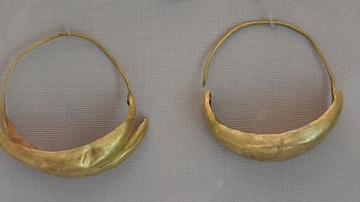
Image
Mesopotamian Gold Earrings
This is a pair of gold boat-shaped earrings, worn by one of Queen Puabi's attendants and was found inside Puabi's grave. Early Dynastic Period, circa 2600 BCE. From the Royal Cemetery at Ur, Southern Mesopotamia, modern-day Iraq. Part of...
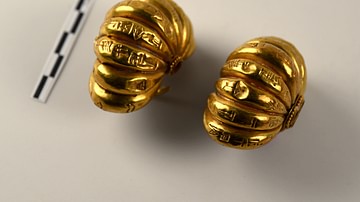
Image
Mesopotamian Gold Earrings, Ur III
Both earrings are placed in a mirror-image position, with the lower surfaces facing each other. Each earring is composed of nine lunar-shaped segments forming a flattened half- ball. The cuneiform signs run vertically from above downward...
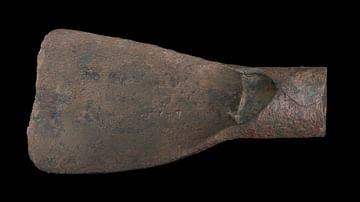
Image
Mesopotamian Hoe
Copper alloy hoe blade with socket, from Ur, Early Dynastic III, 2600-2300 BCE.
The British Museum, London.
Image
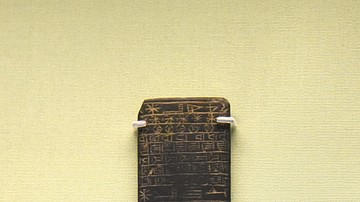
Mesopotamian Amulet Against Ghosts
Stone inscribed with an incantation that has 7 signs, repeated 7 times. It is much worn through use. From Mesopotamia, modern-day Iraq, c. 800-550 BCE.
The British Museum, London.
Image
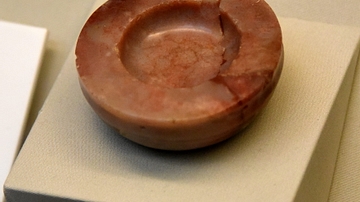
Mesopotamian Cosmetic Bowl
This luxurious marble cosmetic container has an inscriptions marking it as the property of Marduk, god of Babylon. From Sippar, Southern Mesopotamia, Iraq. Circa 625-550 BCE. (The British Museum, London)
Image
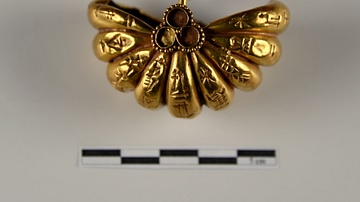
Mesopotamian Gold Earring, Ur III
This is the upper surface of the earring . The right lower circle is broken and at the center of the trifoliate group lies a single golden sphere. The cuneiform text is read vertically, from the upper surface downwards on each segment, and...
Image
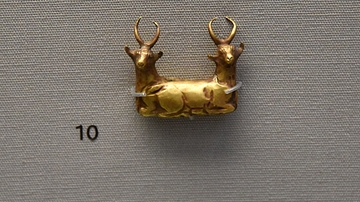
Mesopotamian Antelope Amulet
The antelopes of this amulet were joined at their hindquarters. This gold jewellery was found (together with fish amulets) on Puabi's arm inside her grave. Early Dynastic Period, circa 2600 BCE. From the Royal Cemetery at Ur, Southern Mesopotamia...
Image
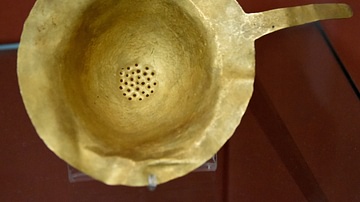
Mesopotamian Gold Strainer
This gold strainer was roughly shaped and has a short handle. It was found at the bottom of the pit of Queen Puabi's grave. Beer and wine were drunk in Mesopotamia from at least the fourth millennium BCE and it is possible that the strainer...
Collection
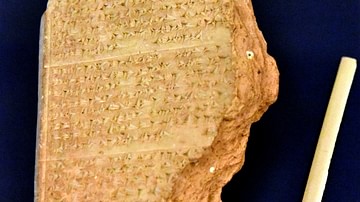
Twelve Stories from the Mesopotamian Scribal School
Sumerian schools (known as edubba, “House of Tablets”) trained the scribes of ancient Mesopotamia in reading, writing, interpretation of texts, general knowledge, and the specifics of whatever field they would eventually work in. The Sumerian...
