
Search
Remove Ads
Advertisement
Search Results

Article
Mesopotamian Education - Creating the First Written Works in History
Mesopotamian education was invented by the Sumerians following the creation of writing circa 3600/3500 BCE. The earliest schools were attached to temples, but later schools were established in separate buildings, in which the scribes of ancient...

Article
Reforms of Catherine the Great
Catherine II of Russia (Catherine the Great) was the empress regent of Russia from 1762 to 1796. During the mid-18th century, Russia was still regarded as culturally behind compared to Western European countries. However, during her reign...

Article
The Eternal Life of Gilgamesh
The Epic of Gilgamesh is among the most popular works of literature in the present day and has influenced countless numbers of readers but, for the greater part of its history, it was lost. The Assyrian Empire fell to a coalition of Babylonians...
Article
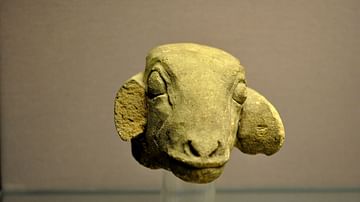
The Debate Between Sheep and Grain
The Debate Between Sheep and Grain (c. 2000 BCE) is one of the best-known Sumerian literary debates in a genre that was popular entertainment by the late 3rd millennium BCE. In this piece, personifications of grain and sheep argue which is...

Article
Passing of Philosophy to Religion: The Death of Hypatia
The death of the philosopher Hypatia of Alexandria (l. c. 370-415) has long been considered the "passage of philosophy to religion", exemplifying the transition from the pagan values of antiquity to those of the new religion of Christianity...

Article
Top 10 Archaeological Sites in Caria, Turkey
Located at the crossroads of many ancient civilizations, Turkey is a haven for archaeology lovers. Over the centuries, a succession of empires and kingdoms – Hittite, Lydian, Persian, Greek, Roman, Byzantine and, finally, Ottoman – ruled...
Article
Poor Man of Nippur
The Poor Man of Nippur (c. 701 BCE) is a Babylonian poem on the themes of the obligations of hospitality and revenge for an undeserved injury. A poor man of the city of Nippur feels mistreated when he visits the mayor and then goes to great...

Interview
Interview: Dithmarschen Republic
Located in what is the present-day German province of Schleswig-Holstein, the Dithmarschen Republic (1227-1559) was a republic by commoners who developed quasi-democratic institutions, including their own written constitution. Fiercely independent...
Interview
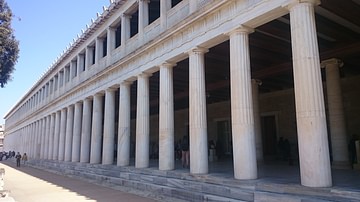
Interview: American School of Classical Studies at Athens
The American School of Classical Studies in Greece has been running its operations since the 19th century CE, with excavations across the country and an academic program that runs throughout the summer and fall. They are arguably the most...

Image
Gallipoli Campaign Map
A map of the Gallipoli Campaign of 1915-6 in the Dardanelles during the First World War (1914-18). (Mitchell Library, State Library of New South Wales)
