
Search
Did you mean: Leo I?
Remove Ads
Advertisement
Search Results

Article
Legions of Mesopotamia, Cappadocia, & Arabia
As the Roman Empire expanded further eastward, annexing territories that were once the domain of the Parthians, the legions of Mesopotamia, Cappadocia, and Arabia were called upon to safeguard these newly acquired territories. Mesopotamia...
Article
Legions of Syria
The Roman legions of Syria served as a buffer, protecting the Roman Empire not only externally from such threats as Parthia and the Sasanian Empire but also internally during the Great Jewish Revolt of 66 CE and the Bar-Kochba Revolt (132-135...
Article
Legions of Britain
After the Roman emperor Claudius (r. 41-54 CE) successfully conquered Britain in 43 CE, four legions were left there to maintain the peace: XIV Gemina, II Augusta, IX Hispana, and XX Valeria Victrix. However, by the end of the decade, XIV...

Article
Legions of Spain, Roman Africa & Egypt
The legions of Spain, Roman Africa, and Egypt did not see the intensity of action that prevailed elsewhere in Europe. However, the presence of these four legions - VII Gemina, IX Hispana, XXII Deiotariana, and II Traiana Fortis - was still...

Image
Legio X Fretensis Inscription on a Sword Belt
Sword belt decoration with the inscription LG X FR FEL: Legio X Fretensis Felix (the fortunate), early 3rd century CE. Israel Museum, Jerusalem.

Definition
Legio II Augusta
Legio II Augusta was a legion of the Roman army that, throughout its centuries-long history, had fought in the Cantabrian Wars of 29-19 BCE, Germanicus' German campaigns in 9 CE, the invasion of Britain in 43 CE, and Septimus Severus' Scottish...
Article
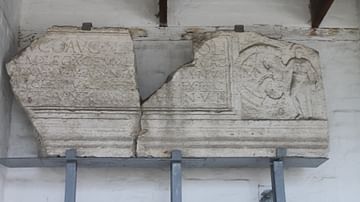
Legions of Judea
Judea was initially dependent on its neighbor Syria for military support until it received a Roman legion of its own in 70 CE after the Great Jewish Revolt of 66 CE. Legio X Fretensis was stationed at remains of the burned city of Jerusalem...

Article
Legions of the Parthian Wars
Parthia had always been a thorn in the side of the Roman Empire. The initial campaigns by Crassus and Mark Antony were total failures, and although Trajan and Syrian governor Cassius made some progress in the 2nd century CE, both failed to...
Image
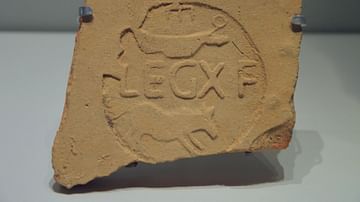
Stamp of Legio X Fretensis
Tile fragment with a stamp of Legio X Fretensis, "LG X F", and its symbol, a wild boar and a battleship. Found in Jerusalem, 1st-2nd century CE. Israel Museum, Jerusalem.
Image
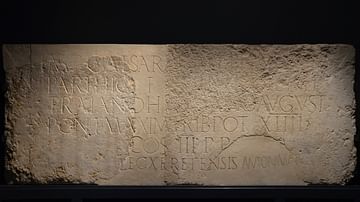
Dedication to Hadrian by Legio X Fretensis
Inscription set up by the soldiers of Legio X Fretensis to coincide with the official visit of Hadrian to Aelia Capitolina in 130 CE. Israel Museum, Jerusalem. ”To the Imperator Caesar Traianus Hadrianus Augustus, son of the deified Traianus...
