
Search
Remove Ads
Advertisement
Search Results

Definition
Kim Yu-sin
Kim Yu-sin (aka Kim Yushin, 595-673 CE) was a general of the Silla kingdom which ruled south-eastern Korea during the Three Kingdoms Period. Kim would greatly help Silla unify Korea, famously leading a massive army to crush the rival kingdom...

Definition
Saint Gall
Saint Gall (c. 550 - c. 645 CE), also known as Saint Gallus, was an Irish monk who lived in what is present-day Switzerland during the 6th century CE and was one of twelve companions of Saint Columbanus' Christian mission to the European...
Definition
Ono no Komachi
Ono no Komachi was a poetess of great renown during the Heian Period (794-1185 CE) of ancient Japan. The Kokinshu anthology, compiled in 905 CE, contains many of her poems, and her work and life inspired later writers of Noh drama. She is...

Article
Cultural Links between India & the Greco-Roman World
Cyrus the Great (558-530 BCE) built the first universal empire, stretching from Greece to the Indus River. This was the famous Achaemenid Empire of Persia. An inscription at Naqsh-i-Rustam, the tomb of his able successor Darius I (521-486...

Article
Iktomi Tales
Iktomi (also known as Unktomi) is a trickster figure of the lore of the Lakota Sioux nation similar to tricksters of other nations, such as Wihio of the Cheyenne, Nanabozho (Manabozho) of the Ojibwe, Coyote of the Navajo, or Glooscap of the...

Article
Sammu-Ramat and Semiramis: The Inspiration and the Myth
Sammu-Ramat (r. 811-806 BCE) was the queen regent of the Assyrian Empire who held the throne for her young son Adad Nirari III (r. 811-783 BCE) until he reached maturity. She is also known as Shammuramat, Sammuramat, and, most notably, as...

Collection
The Arthurian Legend
The Arthurian Legend developed in Europe between c. 830, when the Welsh historian Nennius first mentions King Arthur through c. 1469 when Sir Thomas Malory composes Le Morte D’Arthur, the best-known version of the tales, which was published...

Definition
Sargon of Akkad - From Gardener to King of the Four Corners of the World
Sargon of Akkad (reign 2334-2279 BCE) was the king of the Akkadian Empire of Mesopotamia, the first multinational empire in history, who united the disparate kingdoms of the region under a central authority. He is equally famous today as...

Definition
Chandragupta Maurya
Chandragupta Maurya (c. 321 - c. 297 BCE), known as Sandrakottos (or Sandrokottos) to the Greeks, was the founder of the Maurya Dynasty (4th-2nd century BCE) and is credited with the setting up of the first (nearly) pan-Indian empire. Aided...
Definition
Roman Coinage
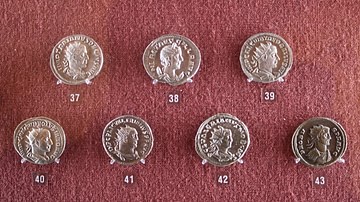
Roman coins were first produced in the late 4th century BCE in Italy and continued to be minted for another eight centuries across the empire. Denominations and values more or less constantly changed but certain types such as the sestertii...
