
Search
Did you mean: Kos?
Search Results

Definition
Chogha Zanbil - The "Basket Mound" of the Gods
Chogha Zanbil (literally "basket mound") is an ancient Elamite temple complex located in the modern-day province of Khuzestan, Iran. It is also known as Dur-Untash (Fortress/City/Town of Untash), Tchogha Zanbil, and Al Untash Napirisha ("Place...
Image
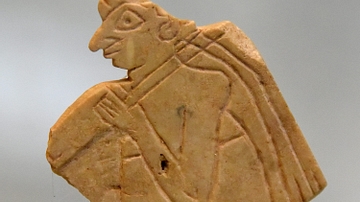
Sumerian Man Holding a Pole
This fragment of a stone inlay was found in Kish. It depicts an incised design of a man wearing the typical Sumerian long robe, carrying a pole on his shoulder. This is probably from a battle scene. The overall depiction of this man is very...

Article
Enuma Elish - The Babylonian Epic of Creation - Full Text
The Enuma Elish (also known as The Seven Tablets of Creation) is the Babylonian creation myth whose title is derived from the opening lines of the piece, "When on High". The myth tells the story of the great god Marduk's victory over the...

Article
Daily Life in Ancient Mesopotamia - Mirroring the Modern World
Daily life in ancient Mesopotamia cannot be described in the same way one would describe life in ancient Rome or Greece. Mesopotamia was never a single, unified civilization, not even under the Akkadian Empire of Sargon of Akkad (the Great...

Article
Ten Ancient Mesopotamia Facts You Need to Know - Fun Facts on the Cradle of Civilization
Mesopotamia is the ancient Greek name (meaning "the land between two rivers," the Tigris and Euphrates) for the region corresponding to modern-day Iraq and parts of Iran, Syria, and Turkey. It is considered the "cradle of civilization" for...

Article
The Curse of Agade - Naram-Sin's Fictional Battle with the Gods
The Curse of Agade (also given as The Cursing of Agade) is a poem dated to the Ur III period of Mesopotamia (circa 2112 to circa 2004 BCE), though it is thought to be somewhat older in origin. It tells the story of the Akkadian king Naram-Sin...

Article
The Legend of Sargon of Akkad - Inspiration for the Story of Moses
The Legend of Sargon of Akkad (circa 2300 BCE) is an Akkadian work from Mesopotamia understood as the autobiography of Sargon of Akkad (Sargon the Great, reign 2334-2279 BCE), founder of the Akkadian Empire. The earliest copy is dated to...

Article
Ten Ancient Elam Facts You Need to Know
Elam, located in the region of the modern-day provinces of Ilam and Khuzestan in Iran, was one of the most impressive civilizations of the ancient world. It was never a cohesive ethnic kingdom or polity but rather a federation of different...

Article
Harappa: An Overview of Harappan Architecture & Town Planning
Harappa is a large village presently in the province of Punjab in Pakistan. The modern town is a part of and lies next to the ancient city. The site of Harappa is important in that it has provided proof of not just the Indus Valley Civilization...

Article
The Nimrud Dogs
The Nimrud Dogs, five canine figurines found at the ancient Mesopotamian city of Nimrud, were only a few of the many startling finds in the region during the 19th century when expeditions were sent to corroborate biblical narratives through...
