
Search
Did you mean: Cimon?
Remove Ads
Advertisement

 This answer was generated by
 Search Results

Definition
Jomon Period
The Jomon Period is the earliest historical era of Japanese history which began around 14500 BCE, coinciding with the Neolithic Period in Europe and Asia, and ended around 300 BCE when the Yayoi Period began. The name Jomon, meaning...

Definition
Jomon Pottery
The Jomon Period (c. 14,500 - c. 300 BCE) of ancient Japan produced a distinctive pottery which distinguishes it from the earlier Paleolithic Age. Jomon pottery vessels are the oldest in the world and their impressed decoration...
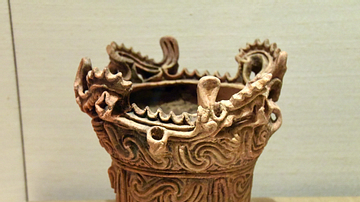
Image
Jomon Flame Pot from Dodaira
"Flame" pots, such as this, are just one type of a long ceramic tradition that continued for some 13,000 years during the Jomon period in Japan. They were made in the Middle Jomon period (3500-2500 BCE) in the area that...
Image
Jomon Bowl (Detail)
A detail of the lip of a deep Jomon bowl. Ubayama Shell Mound, Kashiwai-machi, Ichikawa-shi, Chiba, Japan. Jomon Period, 3000-2000 BCE. (Tokyo National Museum)
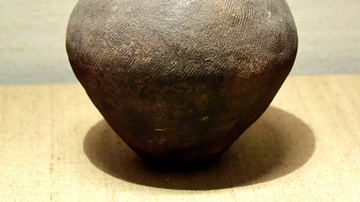
Image
Jomon Ritual Pottery Vessel
These ancient ceramics are decorated with cord markings. They gave the Jomon period, (13,00-500 BCE) its name; Jomon means "cord-marked". A stick was wrapped with braided cord and then rolled over the surface of the vessels...
Image
Jomon Clay Mask
A Jomon clay mask or domen. Kidukuri, Kamegaoka, Tsugaru-shi, Aomori, Japan. Jomon Period, 1000-400 BCE. Important Cultural Property. (Tokyo National Museum)
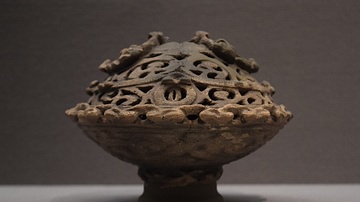
Image
Jomon Incense Burner
A Jomon incense burner. Rokugo Ishinadate, Misato-cho, Akita, Japan. Jomon Period, 1000-400 BCE. (Tokyo National Museum)

Image
Jomon Spouted Vessel
A spouted vessel from Azusawa Shell Mound, Itabashi-ku, Tokyo. Jomon Period 2000-1000 BCE. (Tokyo National Museum)
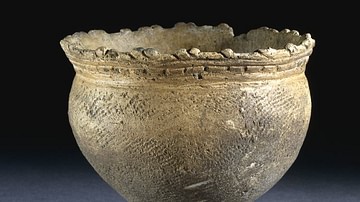
Image
Jomon cup
Earthenware cup decorated with cord-markings from the Late Jomon Period.
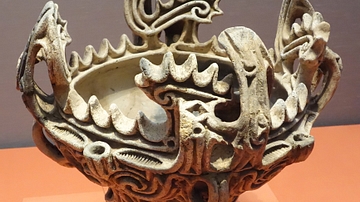
Image
Jomon 'fire-flame' Vessel
A Jomon pottery vessel with the decorative style known as 'fire-flame'. Jomon Period, 3000-2000 BCE, Sasayama site, Niigata Prefecture. Japan. (Tokyo National Museum)
