
Search
Did you mean: Mavia?
Remove Ads
Advertisement

 This answer was generated by
 Search Results
Image
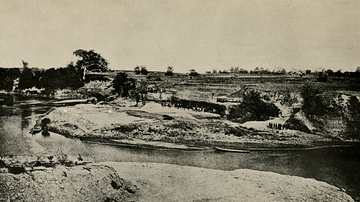
Site of Trinil, Java, Indonesia
Palaeoanthropological site of Trinil, Java, Indonesia, where Eugène Dubois first discovered Pithecanthropus (now Homo) erectus in the 1890s.
Image
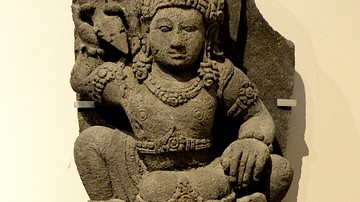
Indra, Java
Indra is the deva (deity, divine, or heavenly) of thunderstorm and rain. He is the leader of the "Devas" and the lord of Svargaloka (heaven in Hinduism). From Java, 11th century CE. (National Museum of Scotland, Edinburgh, UK)
Image
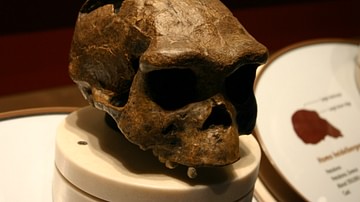
Homo Erectus Skull Cast from Java, Indonesia
Cast of Homo erectus skull Sangiran 17 found at Sangiran, Java, Indonesia. It is around 1 million years old and is on display at the David H. Koch Hall of Human Origins at the Smithsonian Natural History...

Definition
Prambanan
Prambanan (Javanese: Rara Jonggrang) is a Hindu temple complex dating from the 9th century CE located near Bokoharjo, on the island of Java in Indonesia. Prambanan is the largest Hindu temple in Indonesia and one of the largest Hindu...

Definition
Borobudur
The Temple of Borobudur or sometimes "Barabudur" is a Mahayana Buddhist temple located close to Muntilan on the island of Java in Indonesia. Built during the rule of the Sailendra Dynasty (c. 650-1025 CE), Borobudur remains the world's...

Article
Sugar & the Rise of the Plantation System
From a humble beginning as a sweet treat grown in gardens, sugar cane cultivation became an economic powerhouse, and the growing demand for sugar stimulated the colonization of the New World by European powers...

Article
Slavery in Plantation Agriculture
The first plantations in the Americas of sugar cane, cocoa, tobacco, and cotton were maintained and harvested by African slaves controlled by European masters. When African slavery was largely abolished in the mid-1800s...

Article
European Discovery & Conquest of the Spice Islands
Clove, nutmeg, and mace are native to only a handful of tiny islands in the middle of the vast Indonesian archipelago – cloves on five Maluku Islands (the Moluccas) about 1250 km (778 mi) west of New...

Article
Global Trade in the 13th Century
In the 13th century, astonishing quantities of spices and silk passed from the Far East to Europe. Exact amounts are not known, but spice popularity in both cuisine and medicine reached its historical peak during...

Definition
Khmer Empire
The Khmer empire was a powerful state in South East Asia, formed by people of the same name, lasting from 802 CE to 1431 CE. At its peak, the empire covered much of what today is Cambodia, Thailand, Laos, and southern Vietnam. By...
