
Search
Did you mean: Indra?
Remove Ads
Advertisement
Search Results

Definition
Tara
Tara is a female deity in both Hinduism and Buddhism who personifies compassion and offers salvation from the suffering of rebirth and death. She is thought to have been born of empathy for the suffering world and is regularly invoked for...

Definition
Periplus of the Erythraean Sea
The Periplus of the Erythraean Sea is an eyewitness account of ancient travel to Africa and India via the Red Sea written by an unknown Greek-speaking Egyptian author in the 1st century CE. In this detailed account, the conditions of the...
Definition
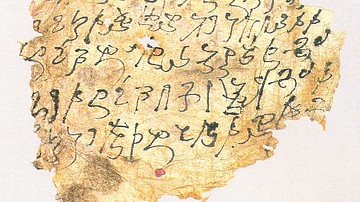
Kharosthi Script
The Kharosthi script (also known as 'Indo-Bactrian' script) was a writing system originally developed in present-day northern Pakistan, sometime between the 4th and 3rd century BCE. Kharosthi was employed to represent a form of Prakrit (Middle...

Definition
Kalash Culture
The Kalash people, also called Kafir (Non-believer), Black Robe and Siah Posh, live in the three sub-valleys of Kalash; Bumboret, Rumbor and Birir, in the modern-day District Chitral, Pakistan. The Kalasha are ancient tribe of Pakistan and...

Definition
Pankration
Pankration is an ancient martial art which mixes wrestling and boxing. The sport can be traced as far back as the second millennium BCE in the territory of ancient Greece. Its name derives from the ancient Greek words pan (all) and kratos...

Definition
Tympanon
The tympanon (tympanum in Latin) was the most popular frame-drum in ancient Greek music, producing a loud rumbling sound not far from the sound of the orchestral timpani drums today. This percussion instrument was played mainly by women on...

Article
Greek Mathematics
Greek mathematics, the study of numbers and their properties, patterns, structure, space, apparent change, and measurement, is said to have originated with Thales of Miletus (l. c. 585 BCE) but was clearly understood during the periods of...

Article
Mesopotamian Inventions - Creating the Future
Mesopotamian inventions include many items taken for granted today, most of which were created during the Early Dynastic period (circa 2900-2350/2334 BCE) or developed from achievements of the Uruk period (circa 4000-3100 BCE). The Sumerians...

Article
Battle of Hydaspes
For almost a decade, Alexander the Great and his army swept across Western Asia and into Egypt, defeating King Darius III and the Persians at the battles of River Granicus, Issus and Gaugamela. Next, despite the objections of the loyal army...

Article
The Unicorn Myth
The unicorn, a mythical creature popularized in European folklore, has captivated the human imagination for over 2,000 years. For most of that time, well into the Middle Ages, people also believed them to be real. The roots of the unicorn...
