
Search
Remove Ads
Advertisement
Search Results
Image
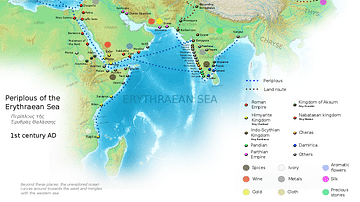
Ancient Indian Maritime Trade Routes
This map is derived from the book Periplus of the Erythraean Sea. It depicts trade routes in the ancient world, ports in the Chera territory and other parts of India and the trade routes connecting them to other...
Image
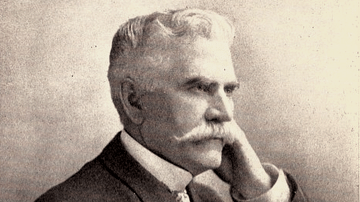
James McLaughlin, US Indian Inspector
James McLaughlin (l. 1842-1923), US Indian Inspector of the Bureau of Indian Affairs, best known for ordering the arrest of the Sioux Chief Sitting Bull in December 1890 and requesting the troops that participated...

Article
Global Trade in the 13th Century
In the 13th century, astonishing quantities of spices and silk passed from the Far East to Europe. Exact amounts are not known, but spice popularity in both cuisine and medicine reached its historical peak during...

Image
Map of the Indian Rebellion of 1857 - Published by J. Barthelemier, Paris
This antique map of India illustrates the Indian Rebellion of 1857, also known as the Sepoy Mutiny. It was published by J. Barthelemier, successor to Ch. Picquet. The map provides a...
Image
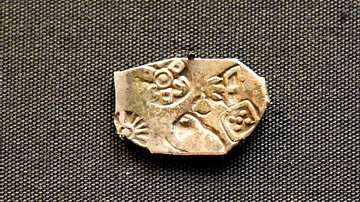
Early Indian Punch-Marked Coin
Early Indian coins were made by cutting sheets of silver into pieces and marking each piece with one or more symbols using small punches. As there are no portraits or inscriptions, the coins are now known by numbers...
Image
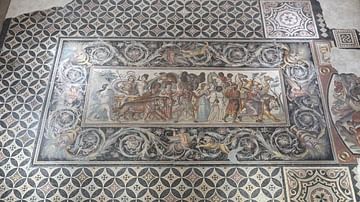
Indian Triumph of Dionysus Mosaic
The Indian Triumph of Dionysus mosaic once decorated a dining room (triclinium) in Setifis, a colony for Roman veterans founded during the reign of Nerva (r. 96-98 CE). The central panel of the mosaic depicts the...

Image
Indian Massacre of 1622
Indian Massacre of 1622. A colorized version of a woodcut by Matthaeus Merian published along with Theodore de Bry's earlier engravings in a book on the New World, 1628. The engraving shows the 1622 massacre when Powhatan...
Image
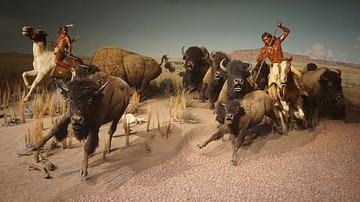
The Crow Indian Buffalo Hunt Diorama
The Crow Indian Bison Hunt diorama.
The North American Indians: A Tribute to Survival exhibit, Milwaukee Public Museum in Milwaukee, Wisconsin, USA.

Image
North American Indian Warrior by John White
An illustration by John White (d. 1593 CE) of a North American Indian warrior seen by the first English colonists who attempted to establish a settlement, Roanoke Colony, in 1585 CE (and again in 1587 CE...
Image
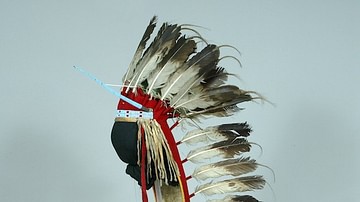
Plains Indian Headdress
Plains Indian headdress such as would have been worn by Roman Nose (Cheyenne warrior) in the 19th century.
The Children’s Museum of Indianapolis, USA.
