
Search
Remove Ads
Advertisement
Search Results

Definition
Zorvanism
Zorvanism (also given as Zuvanism, Zurvanism) was a sect of the Persian religion Zoroastrianism which emerged in the late Achaemenid Empire (c. 550-330 BCE) and flourished during the Sassanian Empire (224-651 CE). It is often referenced...

Article
The Delian League, Part 1: Origins Down to the Battle of Eurymedon (480/79-465/4 BCE)
This text is part of an article series on the Delian League. The modern term Delian League refers to the primarily maritime συμμᾰχία or symmachy (offensive-defensive alliance...

Image Gallery
Europe 1914–1949: History Maps of the World Wars
This map collection explores the geopolitical transformation of Europe between 1914 and 1949. From the First World War (1914-18) and the collapse of empires to the rise of fascism, communism, and totalitarian...

Article
Inventions & Innovations of Ancient Persia
Ancient Persian culture contributed many of the aspects of the modern world which people take for granted as having always existed. The designation “Persia” comes from the Greeks – primarily from the historian...

Article
Death and the Afterlife in Ancient Persia
A vision of the afterlife is articulated by every culture, ancient or modern, in an effort to answer the question of what happens after death. Ancient Persia had the same interest in this as any culture of...

Article
Achaemenid Kings List & Commentary
The Achaemenid Empire (c. 550-330 BCE) was the first great Persian political entity in Western and Central Asia which stretched, at its peak, from Asia Minor to the Indus Valley and Mesopotamia through Egypt. It...

Article
Women in Ancient Persia
Women in ancient Persia were not only highly respected but, in many cases, considered the equals of males. Women could own land, conduct business, received equal pay, could travel freely on their own, and in the case of...

Article
Some new hypotheses on the problems of the Indo-Greek kingdoms
Warning: See the definitions of Greco-Bactrian and Indo-Greek Kingdoms before reading this article, otherwise the following lines could give you serious headaches! A lack of information is...

Definition
Cyrus the Great
Cyrus II (d. 530 BCE), also known as Cyrus the Great, was the fourth king of Anshan and the first king of the Achaemenid Empire. Cyrus led several military campaigns against the most powerful kingdoms of the time, including Media...
Image
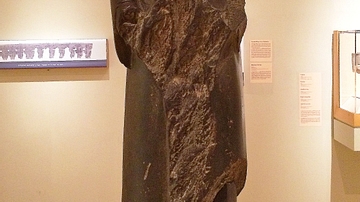
Statue of the Egypto-Persian Ptahhotep
This statue of Ptahhotep (who was the Overseer of the Treasury) is shown in a Persian costume that Egyptian officials adopted when Egypt was under Persian control. The jacket with flaring sleeves, over which...
