
Search
Did you mean: Grattage?
Remove Ads
Advertisement

 This answer was generated by
 Search Results
Image
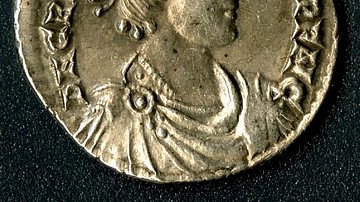
Gratian
Silver coin depicting Gratian. Minted in Trier, found in England, part of the Hoxne hoard.

Definition
Magnus Maximus
Magnus Maximus (c. 355 - August 28, 388 CE) was a Roman usurper and Western Roman Emperor from 383-388 CE. He was a prominent general in the Roman army, particularly in the province of Britain. In 383 CE he usurped the Western...
Definition
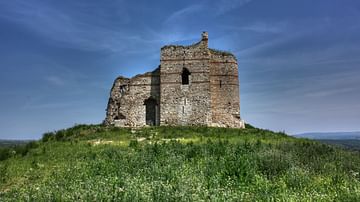
Fritigern
Fritigern (also Fritigernus, died c. 380 CE) was a Visigothic king best known as the victor of the decisive Battle of Adrianople in 378 CE, which decimated the Roman army and haunted Roman military commanders for decades afterwards...

Definition
Battle of Adrianople
The Battle of Adrianople on August 9, 378 CE ranks among the worst military defeats in all of Roman history. Its estimated losses of over 10,000 are comparable to Roman defeats at Cannae (216 BCE) and Carrhae (53 BCE). The...

Definition
Roman Literature
The Roman Empire and its predecessor the Roman Republic produced an abundance of celebrated literature; poetry, comedies, dramas, histories, and philosophical tracts; the Romans avoided tragedies. Much of it survives to this day...

Definition
Western Roman Empire
The Western Roman Empire is the modern-day term for the western half of the Roman Empire after it was divided in two by the emperor Diocletian (r. 284-305 CE) in c. 285/286 CE. The Romans themselves did not use this term...

Article
Continuity and Change after the Fall of the Roman Empire
The cataclysmic end of the Roman Empire in the West has tended to mask the underlying features of continuity. The map of Europe in the year 500 would have been unrecognizable to anyone living a...
Article
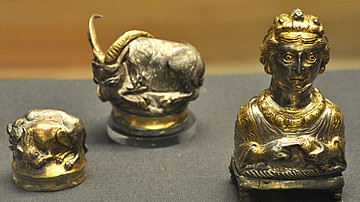
The Roman Hoxne Hoard
The Hoxne Hoard is the largest cache of late Roman gold found anywhere in the Roman Empire. Discovered by a metal detectorist in Suffolk, in the east of England in 1992 CE, the incredible collection contains 14,865 late-4th...

Article
Mavia's Revolt & the Christian Question
In 378 CE the Tanukhid queen Mavia (r. c. 375 - c. 425 CE) of the Saracens led a successful revolt against the Roman Empire, pitting her forces against the armies under the emperor Valens (364-378 CE). Launching...

Image
Ausonius
Statue of the Roman poet Ausonius (c. 310–c. 395 CE) in the village of Neumagen-Dhron in Germany. Decimius Magnus Ausonius was from Burdigala (modern Bordeaux in France) and was tutor to the future emperor Gratian, who afterwards bestowed...
