
Search
Remove Ads
Advertisement
Search Results

Article
Hesiod on the Birth of the Gods
The Greek poet Hesiod (c. 700 BCE) is most famous for his works Theogony and Works and Days. In this passage from Theogony, Hesiod relates the birth of the gods from cosmic Chaos and follows the lineage through the great Zeus, King of the...

Article
Gods & Goddesses of Ancient Egypt - A Brief History
The land of ancient Egypt was alive with the spirit of the gods. The sun god Ra broke from the darkness every morning in his great boat, bringing the light, and many of the gods watched over the people by night as the stars. Osiris caused...

Article
The Mesopotamian Pantheon - The Ancient Gods and Goddesses of the Near East
The gods of the Mesopotamian region were not uniform in name, power, provenance or status in the hierarchy. Mesopotamian culture varied from region to region and, because of this, Marduk should not be regarded as King of the Gods in the same...

Article
Most Popular Gods & Goddesses of Ancient China
There were over 200 gods and goddesses worshipped throughout ancient China, but if one were to count every deity or spirit, the number would be over 1,000. Each town, village, city, field, farm, and sometimes even separate plot in a graveyard...
Article
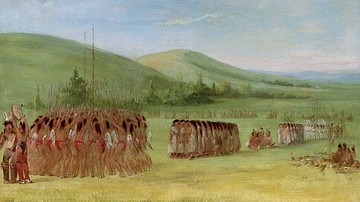
Ûñtsaiyĭ', the Gambler
Ûñtsaiyĭ', the Gambler is a legend of the Cherokee nation, known as a Wonder Story, which features supernatural characters, sometimes interacting with mortals, sometimes with each other. In Ûñtsaiyĭ', the Gambler, all the characters are supernatural...

Definition
Religion in the Ancient World - Order and the Spiritual Experience
Religion (from the Latin Religio, meaning "restraint," or Relegere, according to Cicero, meaning "to repeat, to read again," or, most likely, Religionem, "to show respect for what is sacred") is an organized system of beliefs and practices...

Article
Twelve Gods of Persian Mythology
Ancient Persian Mythology is the term now referencing ancient Iranian religion prior to the rise of Zoroastrianism between c. 1500-1000 BCE. This was a polytheistic faith with a pantheon led by the supreme god Ahura Mazda (“Lord of Wisdom”...

Definition
Shinto
Shinto means 'way of the gods' and it is the oldest religion in Japan. Shinto's key concepts include purity, harmony, family respect, and subordination of the individual before the group. The faith has no founder or prophets and there is...

Article
Ancient Persian Gods, Heroes, and Creatures - The Complete List
The term 'mythology' comes from the Greek mythos (story-of-the-people) and logos (word or speech), meaning the spoken story of a people. Every civilization of the ancient world developed a belief system, which is characterized as 'mythology'...

Article
Ships of the Gods of Ancient Egypt
The Nile River was the source of life for the ancient Egyptians and so figured prominently in their religious beliefs. At night, the Milky Way was considered a heavenly Nile, associated with Hathor, and provider of all good things. The Nile...
