
Search
Did you mean: Ur?
Remove Ads
Advertisement
Search Results

Interview
Interview: The Ancient Southwest
Pre-Columbian civilizations of the Southwestern United States and Northern Mexico include the Hohokam who occupied the US state of Arizona, the Anasazi or Ancestral Pueblo Peoples who resided in the Four Corners Region...
Article
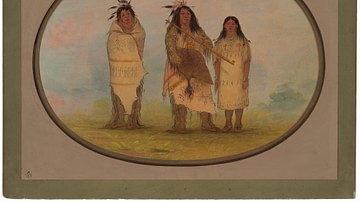
The Life and Death of Sweet Medicine
The Life and Death of Sweet Medicine is a Cheyenne tale of the great prophet and law-giver Sweet Medicine who received the sacred Four Arrows, structure of government, and rules of society from Maheo, the Wise...
Article
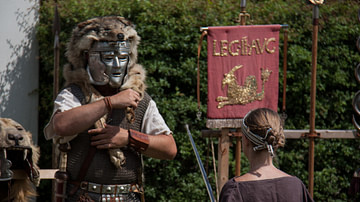
Legions of Britain
After the Roman emperor Claudius (r. 41-54 CE) successfully conquered Britain in 43 CE, four legions were left there to maintain the peace: XIV Gemina, II Augusta, IX Hispana, and XX Valeria Victrix. However, by the end of the...

Article
Diodorus Siculus' Account of the Life of Semiramis
Semiramis is the semi-divine Warrior-Queen of Assyria, whose reign is most clearly documented by the Greek historian Diodorus Siculus (l. 90-30 BCE) in his great work Bibliotheca Historica ("Historical...
Article
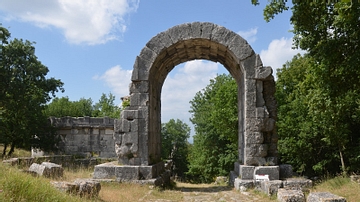
Visitor’s Guide to Carsulae (San Damiano)
Carsulae in Umbria, central Italy, was founded c. 300 BCE and only became a prosperous urban centre after it was connected by the Via Flaminia towards the end of the 3rd century BCE. It was granted the status...
Article
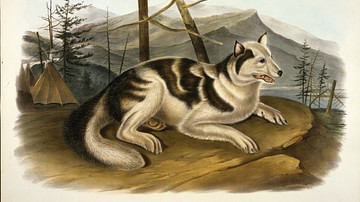
Sees-In-The-Night
Sees In The Night (Sees-In-The-Night) is a Cheyenne tale of a young, poor boy who, through the kindness shown to a dog, becomes a great warrior and chief of his people. The story emphasizes the Cheyenne value of kindness toward...

Image
Timeline of Roman Emperors 27 BCE to 285 CE - Stability, Succession, and Crisis in the Early Roman Empire
The period from Augustus (reign 27 BCE-14 CE) to Diocletian (reign 284-305 CE) marks the consolidation and transformation of Roman imperial rule across nearly...

Definition
Mongol Empire
The Mongol Empire (1206-1368) was founded by Genghis Khan (r. 1206-1227), first Great Khan or 'universal ruler' of the Mongol peoples. Genghis forged the empire by uniting nomadic tribes of the Asian steppe and creating a devastatingly...
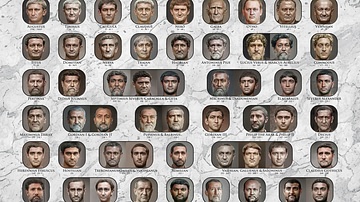
Image
Artistic Facial Reconstructions of Roman Emperors
A poster with facial reconstructions of Roman emperors who ruled during the Principate, from the reign of Augustus (r. 27 BCE-14 CE) to Carinus (r. 283-285 CE). These photorealistic representations...

Image
Seated Buddha from Gandhara
This Seated Buddha was found in Gandhara, Pakistan (100-300 CE).
This image was taken at the National Museum of Australia in the travelling exhibition A History of the World in 100 (and 1) Objects.
