
Search
Did you mean: Shinto?
Remove Ads
Advertisement
Search Results

Article
The Unseen Helpers
The Unseen Helpers is a Cherokee tale on the importance of kindness. Generosity is a central cultural value of the Cherokee nation, as it is with Native American nations generally, and is regarded as especially praiseworthy...

Article
Battle of Germantown
The Battle of Germantown (4 October 1777) was a major battle of the American Revolutionary War (1775-1783) in which General George Washington launched an unsuccessful assault on the British army garrisoned in Germantown, Pennsylvania...

Article
Ethnicity & Identity Within the Four-Room House
The process of determining ethnicity is a problematic venture, even more so when interpreted through the archaeological record. Despite this issue, evidence, such as the four-room house, has been preserved...

Article
The Little Girl and the Ghost
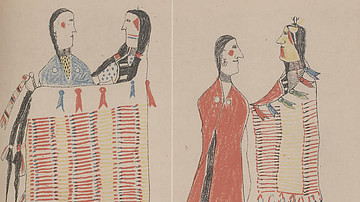
The Little Girl and the Ghost is a legend of the Cheyenne nation concerning a young girl abducted by a spirit after she is cast out by her mother. The story explores many themes common in Cheyenne literature, including...
Article
Ehyophsta Legend
Ehyophsta is a Cheyenne legend of the heroine, Ehyophsta, the Yellow Haired Woman, who first brought the buffalo to the people. When she accidentally breaks a taboo, the buffalo vanish until they are brought back later by the...

Article
White Plume
White Plume is a hero tale of the Sioux nation featuring the supernatural trickster figure Unktomi (Iktomi) who serves as a catalyst for transformation, whether for good or ill. In this story, Unktomi is the villain whereas in others...

Article
G. H. Thomas's Account of the Battle of Mill Springs - Excerpts From the Official Action Report
At the Battle of Mill Springs (19 January 1862) in Kentucky, Union Brigadier General George H. Thomas had originally planned to strike first, advancing from Logan's...

Image
Aztec Ceremonial Knife
An Aztec ceremonial knife with a cedarwood handle and flint blade. The figure of the handle is covered in turquoise and shell mosiac and represents an Aztec Eagle knight. 1400-1521 CE. (British Museum, London)
Image
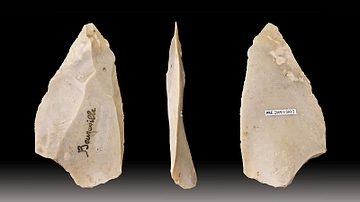
Neanderthal Tools - Levallois Point
A Levallois point flint tool from the Mousterian lithic industry, made by Neanderthals. It was discovered in Beuzeville, France and is on display at the museum of Toulouse, France.
Image
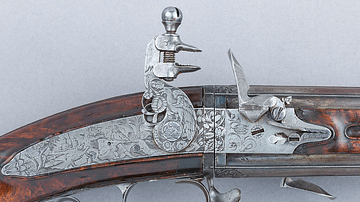
17th-Century Flintlock Mechanism
An example of a 17th-century flintlock firearm mechanism. A piece of flint was held in the vice which the trigger pulled down to strike a metal bar which created a spark to ignite the priming powder which then set...
