
Search
Did you mean: Epicurus?
Remove Ads
Advertisement
Search Results

Article
Winged Victory: the Nike of Samothrace
One of the most celebrated works of Hellenistic art is without doubt the Nike of Samothrace, on display at the Louvre since 1884 CE. The white Parian marble statue represents the personification of winged victory. In a sense, the impact of...

Article
Elephants in Greek & Roman Warfare
In the search for ever more impressive and lethal weapons to shock the enemy and bring total victory the armies of ancient Greece, Carthage, and even sometimes Rome turned to the elephant. Huge, exotic, and frightening the life out of an...
Article
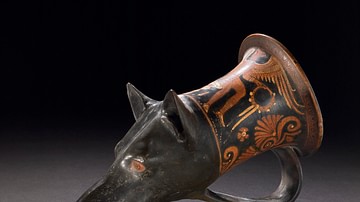
Dogs & Their Collars in Ancient Greece
Dogs in ancient Greece are regularly depicted in art, on ceramics, in literature, and other written works as loyal companions, guardians, hunters, and even as great intuitive thinkers; all of these expressing the deep admiration the Greeks...
Article
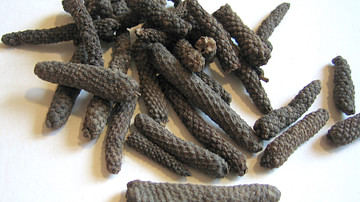
Middle Eastern Power Shifts & the Trade of Pepper from East to West
Pepper has long been the king of spices and for almost 2,000 years dominated world trade. Originating in India, it was known in Greece by the 4th century BCE and was an integral part of the Roman diet by 30 BCE. It remained a force in Europe...

Article
The Celtic Invasion of Greece
Between the 5th and 4th centuries BCE, Celtic tribes moved en masse into southern Europe, intent on seizing land and wealth to feed their swelling numbers. As these tribes began crossing the Alps, they came into conflict with the Romans and...
Article
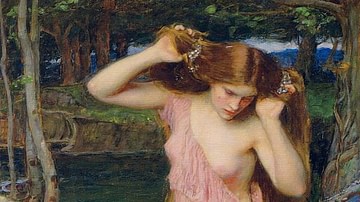
An Ancient Ghost Story: Philinnion & Machates
Ghost stories have existed for thousands of years, often in similar forms and frequently dealing with the same themes, in many of the most ancient cultures. The writer H.P. Lovecraft once wrote, "As may naturally be expected of a form so...

Article
Elephants in Hellenistic History & Art
Elephants were thought of as fierce and frightful monsters in antiquity, very real though rarely seen until the Hellenistic period. They were deployed on the battlefield to strike terror into the enemy, however, since fear was considered...
Article
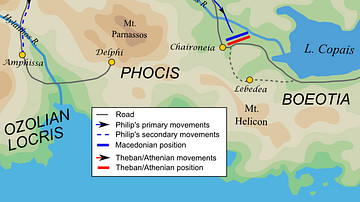
The Battle of Chaeronea in Diodorus Siculus
Chaeronea is the site of the famous Battle of Chaeronea (338 BCE) Phillip II of Macedon's decisive defeat of the Greek city-states. At Chaeronea in Boeotia (north of Corinth) Phillip and his allies from Thessaly, Epirus, Aetolia, Northern...

Video
Olympias: Mother to Alexander the Great and Second Wife of Phillip II of Macedon
Olympias, born with the name Myrtle, was the daughter of Neoptolemus, the king of Epirus, which was a Greek kingdom southwest of Macedonia and became the second wife of Philip II of Macedon, and is probably best known as the mother of Alexander...

Image
Map of the Byzantine Empire, c.520 - 1204
This map illustrates the shifting frontiers of the Byzantine Empire from the accession of Justinian I (reign circa 527 - 565) to the Fourth Crusade's sack of Constantinople in 1204, showing how the Greek-speaking eastern Roman state acted...
