
Search
Search Results

Image
Robert Clive & The East India Company Rule in India, c. 1765
A map illustrating the transformation of the East India Company from a hopeful merchant venture in 1600 with isolated trade outposts governed by isolated and mostly independent town councils into a major ruler of large territories in India...

Article
Cultural Links between India & the Greco-Roman World
Cyrus the Great (558-530 BCE) built the first universal empire, stretching from Greece to the Indus River. This was the famous Achaemenid Empire of Persia. An inscription at Naqsh-i-Rustam, the tomb of his able successor Darius I (521-486...

Article
European Discovery & Conquest of Sri Lanka
The island of Sri Lanka (formerly known as Ceylon) became a focus of European attention soon after the Portuguese entry into the Indian Ocean in the late 15th century. Large swaths of the island would come first under Portuguese control...

Video
History of the English East India Company
Did you know the English East India Company’s tea trade was fueled by the opium trade? The English East India Company (EIC) – also known as the British East India Company – was an immensely successful trading company founded in 1600...

Definition
Robert Clive
Robert Clive (1725-1774), also known as 'Clive of India' and Baron Clive of Plassey, masterminded the expansion of the East India Company in India. Best known for his victory at Plassey in Bengal in 1757, Clive's reputation suffered in his...
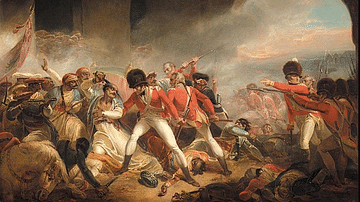
Definition
Anglo-Mysore Wars
The Four Anglo-Mysore Wars (1767-1799) were fought between the British East India Company (EIC) and the state of Mysore. Haidar Ali and his son Tipu Sultan, the "Tiger of Mysore", were relentless foes to British expansion in southern India...

Definition
German East Africa
German East Africa (Deutsch-Ostafrika) was a colony of Imperial Germany from 1885 until 1918. The territory, much larger than Germany itself, covered what is today Tanzania, Rwanda, Burundi, and part of Mozambique. As in many other European...

Definition
Indian Princely States
The Indian Princely states (aka Native States or Princely India) were those states in the Indian subcontinent the British did not conquer but which were typically bound by treaty first to the East India Company and then to the British Crown...

Image
Map of the East India Company Trade, c.1800
The English East India Company (EIC) was established by Royal Charter on 31 December 1600 under Queen Elizabeth I (reign 1558–1603), granting it a monopoly on English trade east of the Cape of Good Hope. Initially conceived as a commercial...

Image
East India Company Fort, Bombay
A c. 1665 illustration of the British East India Company's fort at Bombay (now Mumbai). (National Archives of the Netherlands, The Hague)
