
Search
Did you mean: Xois?
Remove Ads
Advertisement
Search Results

Article
A Brief History of Veterinary Medicine
The English word 'veterinarian' as defining one who provides medical care to animals, comes from the Latin verb veheri meaning “to draw” (as in "pull") and was first applied to those who cared for “any animal...

Article
Battle of Guam - The US Takes Back its Territory in WWII
The Battle of Guam, in the Mariana Islands, took place in July and August 1944 during the Pacific War of the Second World War (1939-45). Guam had been US territory prior to the conflict but was...

Article
Glooscap Tales
The Glooscap tales are legends of the Eastern Algonquin nations of the Wabanaki Confederacy – the Abenaki, Mi'kmaq, Passamaquoddy, Penobscot, and Wolastoqiyik – featuring the supernatural entity Glooscap, who is depicted sometimes...

Article
The Nerge: Hunting in the Mongol Empire
The peoples of the Mongol Empire (1206-1368 CE) were nomadic, and they relied on hunting wild game as a valuable source of protein. The Asian steppe is a desolate, windy, and often bitterly cold environment...
Article
A Story of Faith
A Story of Faith is a legend of the Pawnee nation similar in theme to The Boy Who Was Sacrificed and featuring the same sacred animals – the Nahu'rac – who serve Ti-ra'wa ("Father Above") from their homes in five mystical places...
Image
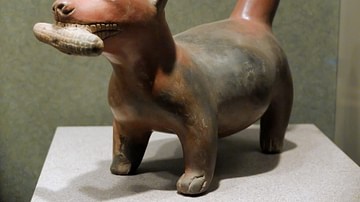
Colima Dog with Maize
Statue of a dog holding a cob of maize (corn) in its mouth, from Colima, Mexico, c. 100 BCE to 300 CE.
National Museum of Anthropology, Mexico City.

Image
Mesoamerican Red Dog Effigy
Earthenware effigy of a dog from Colima, Mexico, c. 100 BCE to 300 CE.
Walters Art Museum, Balitmore.

Image
Reclining Colima Dog
Ceramic sculpture of a reclining dog. Associated with the Comala people. Colima, Mexico. c. 200 BCE-300 CE. Collection of the Metropolitan Museum of Art.

Image
Mesoamerican Dog Effigy
Red slip effigy of a dog. Made in Colima, Mexico, 100 BCE-300 CE.
Walters Art Museum, Baltimore.

Image
Mesoamerican Canine Vessel
Ceramic Mesoamerican canine vessel from South-Central Veracruz, Mexico, c. 600 to c. 900. This open ceramic bowl from the Veracruz Late Classic period features a mould-made effigy of a canine resembling a xoloitzcuintle...
