
Search
Remove Ads
Advertisement
Search Results

Definition
Melissus of Samos
Melissus of Samos (l. c. 5th century BCE) was a Greek philosopher of the Eleatic School, considered the third great proponent of that philosophy's claim that reality is One, after Parmenides (l. c. 485 BCE) and Zeno of Elea (l...
Article
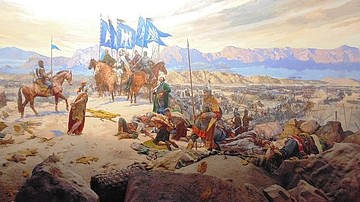
Battle of Manzikert
The Battle of Manzikert (Mantzikert) in ancient Armenia in August 1071 CE was one of the greatest defeats suffered by the Byzantine Empire. The victorious Seljuk army captured the Byzantine emperor Romanos IV Diogenes, and...

Definition
Anaximenes
Anaximenes of Miletus (l. c. 546 BCE) was a younger contemporary of Anaximander and generally regarded as his student. Known as the Third Philosopher of the Milesian School after Thales (l. c. 585 BCE) and Anaximander (l. c. 610 -...
Definition
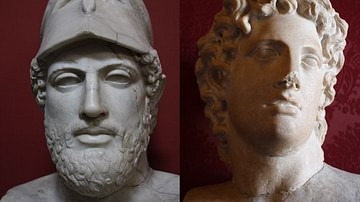
Plutarch
L. Mestrius Plutarchus, better known simply as Plutarch, was a Greek writer and philosopher who lived between c. 45-50 CE and c. 120-125 CE. A prodigious and hugely influential writer, he is now most famous for his biographical works...

Article
Heraclitus' Fragments
Heraclitus of Ephesos (l. c. 500 BCE) was an early Pre-Socratic philospher who claimed that the First Cause of existence was fire and that life itself was characterized by strife and change. Heraclitus did not see this condition...

Article
Plato's Euthyphro: An Overlooked Comedy
Plato's Euthyphro is a Socratic dialogue on the concept of piety whose meaning and purpose continue to be debated. In reading the work only as a serious inquiry into the definition of an abstract concept, however...
Definition
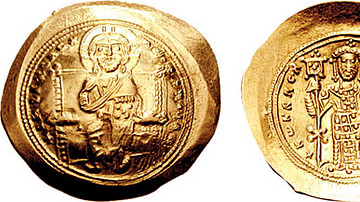
Constantine X Doukas
Constantine X Doukas was the ruler of the Byzantine Empire from 1059 to 1067 CE. During his reign, the Byzantine Empire was attacked by emerging enemies on all sides, including the Normans in Italy and the Seljuk Turks in...

Definition
Religion in the Ancient World - Order and the Spiritual Experience
Religion (from the Latin Religio, meaning "restraint," or Relegere, according to Cicero, meaning "to repeat, to read again," or, most likely, Religionem, "to show respect for what is sacred"...

Definition
Socrates
Socrates of Athens (l. c. 470/469-399 BCE) is among the most famous figures in world history for his contributions to the development of ancient Greek philosophy which provided the foundation for all of Western Philosophy. He is, in...

Definition
Democritus
Democritus (l. c. 460 - c. 370 BCE) was a Greek philosopher and younger contemporary of Socrates, born in Abdera (though other sources cite Miletus) who, with his teacher Leucippus (l. 5th century BCE), was the first to propose an...
