
Search
Remove Ads
Advertisement

 This answer was generated by
 Search Results

Definition
René Descartes
René Descartes (1596-1650) was a French mathematician, natural scientist, and philosopher, best known by the phrase 'Cogito ergo sum' ('I think therefore I am'). He published works on optics, coordinate geometry, physiology, and cosmology...

Image
Descartes' House
Maison Descartes, the house where the philosopher René Descartes (1596-1650) lived in the Netherlands.
De Weteringschans, Amsterdam.
Image
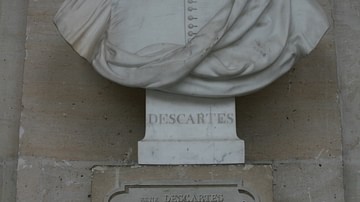
Descartes Bust
Bust of French philosopher René Descartes (1596-1650.)
Versailles.
Image
René Descartes
Portrait of René Descartes (1596-1650), after Frans Hals, c. 1649-1700.
Louvre, Paris.

Definition
The Enlightenment
The Enlightenment (Age of Reason) was a revolution in thought in Europe and North America from the late 17th century to the late 18th century. The Enlightenment involved new approaches in philosophy, science, and politics. Above all, the...

Article
Dogs & Their Collars in the Age of Enlightenment - From "Machines" to Pampered Pets
In medieval and Renaissance Europe, dogs were considered little more than "machines" which performed certain tasks, such as guarding a home or tracking game, but this view changed significantly during the Age of Enlightenment (also known...
Article
Anselm's Proslogion
The Proslogion (Latin for Address or Discourse; the title was chosen because it is written in the form of a prayer addressed to God) is a book written by the medieval theologian St. Anselm of Canterbury (c. 1033-1109). It is of great significance...

Definition
Thomas Hobbes
Thomas Hobbes (1588-1679) was an English philosopher who famously summarised his pessimistic view of human nature in his greatest work, Leviathan, published in 1651. Hobbes believed that the life of humanity in the state of nature is short...
Definition
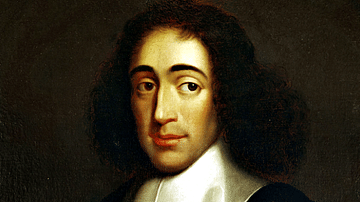
Baruch Spinoza
Baruch Spinoza (1632-1677) was a Dutch philosopher who combined rationalism and metaphysics to create a unique system of thought. Spinoza was held up as an atheist philosopher in the 18th century, but this is not an entirely accurate representation...

Article
Women Scientists in the Scientific Revolution
Women scientists during the Scientific Revolution (1500-1700) were few in number because male-dominated educational institutions, as well as scientific societies and academies, barred women entry, meaning that few had the education or opportunity...
